



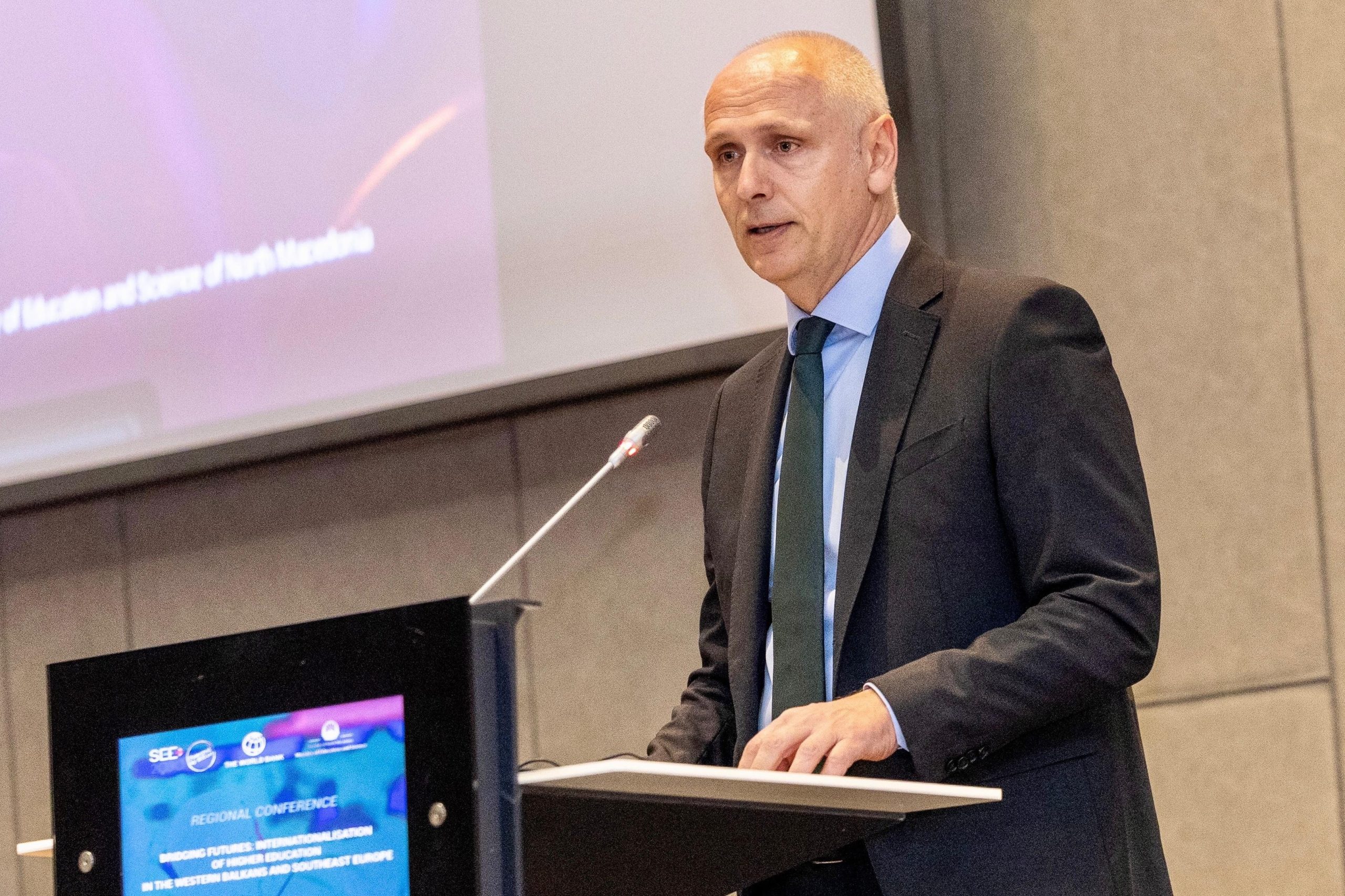
The Regional Cooperation Council (RCC), the World Bank, and North Macedonia’s Ministry of Education and Science on Thursday launched a regional conference on higher education internationalisation in the Western Balkans and Southeast Europe.
The event, titled “Bridging Futures: Internationalisation of Higher Education in the Western Balkans and Southeast Europe,” aims to advance regional cooperation in higher education at a time when digitalisation, global competition, and mobility are reshaping education systems. It brings together education ministers, policymakers, university leaders, quality assurance bodies, industry representatives, and international experts from across the region.
Vesna Janevska, North Macedonia’s Minister of Education and Science, opened the conference alongside RCC Secretary General Amer Kapetanovic and Xiaoqing Yu, World Bank Division Director for the Western Balkans. Janevska emphasized the need to move beyond dialogue to develop a practical regional roadmap that promotes quality, excellence, and opportunities for students, researchers, and universities.
“By hosting this conference under its patronage, the Government of North Macedonia highlights the importance of regional cooperation and follow-up action. Our objective is to ensure that higher education in the region is relevant, innovative, and aligned with international standards,” Janevska said.
Amer Kapetanovic said regional cooperation is critical to strengthen education systems and provide real opportunities for young people.
“In a world where information moves instantly, education systems must ensure that knowledge keeps its value. For the Western Balkans, this means improving mobility, enhancing quality, and better connecting our systems. The region has already made important steps to reduce barriers, enabling students and professionals to move, learn, and work more freely. The next step is alignment, comparability, and real opportunities across the region. Regional cooperation is not an option, it is essential,” Kapetanovic said.
Xiaoqing Yu said the conference demonstrates the benefits of a regional approach to higher education, where universities and industry collaborate across borders to co-create skills, innovations, and workforce opportunities.
“Internationalisation allows the region to collaborate rather than compete. Partnerships between universities and industry can produce results that no single institution could achieve alone,” Yu said.
The conference includes a ministerial roundtable on global competitiveness and European Union (EU) alignment, along with policy panels on student mobility, innovation, industry partnerships, quality assurance, governance, and financing. Thematic working sessions focus on implementing policy priorities and best practices, covering governance and quality assurance, university-industry cooperation, youth mobility, and brain circulation.
As countries in the Western Balkans progress toward EU membership, internationalisation of higher education is increasingly seen as a shared regional agenda. Efforts build on achievements from the Common Regional Market, including agreements that facilitate student mobility, mutual recognition of professional qualifications, and reduced barriers to cross-border movement. The conference explores how regional cooperation can strengthen the quality, relevance, and impact of higher education systems.
The outcomes of the conference will inform a draft regional policy note and roadmap on higher education internationalisation. This document is expected to consolidate good practices, identify priority actions, and provide guidance for coordinated regional collaboration.
“The conference will help establish a framework for continued cooperation, aligning higher education systems across the region, and ensuring that students, researchers, and professionals can fully benefit from international opportunities,” the RCC said in a statement.
The event marks one of the largest regional gatherings on higher education in Southeast Europe this year and reflects growing recognition that the future competitiveness of the Western Balkans depends on strong, internationally connected education systems.