


TIRANA, June 28 (BalkanView) – What started as a local environmental protest against the construction of a luxury tourism project in southern Albania has, within weeks, evolved into the country’s largest civic mobilization since the fall of communism.
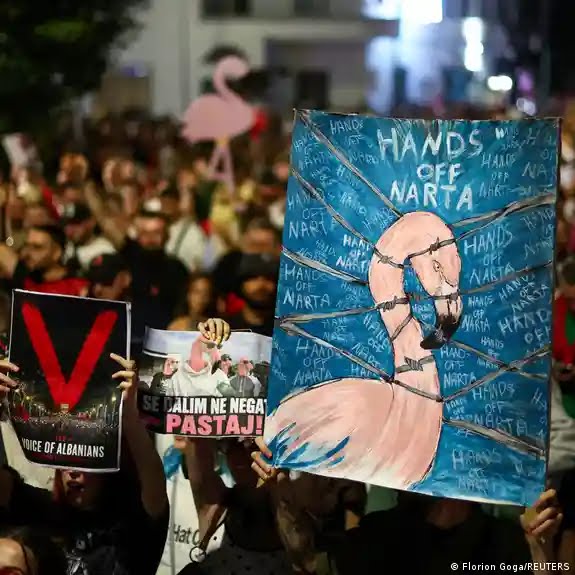
Every evening at 7 p.m., thousands of protesters gather in central Tirana carrying pink flamingo symbols – the bird that has become the emblem of opposition to a luxury resort project planned in the protected Vjosa-Narta area and linked to a company owned by Jared Kushner, son-in-law of U.S. President Donald Trump.
But as demonstrations continue to grow, it has become increasingly clear that the movement extends far beyond environmental concerns.
From environmental dispute to political crisis
The turning point came on May 30, when videos circulated on social media showing a protester being dragged across the sand by private security personnel while police officers looked on.
The footage triggered widespread outrage.
“That was the moment when the public no longer saw a dispute over land, but a broader question about the relationship between the state and its citizens,” political analyst Artan Fuga said.
According to Fuga, the incident transformed a local environmental campaign into a national debate about the rule of law, political power and democratic accountability.
Rama’s “hybrid war” narrative
Prime Minister Edi Rama has offered a very different interpretation.
He argues that the protests cannot be explained solely as domestic political discontent, but rather as part of a “hybrid war” involving foreign influence operations, digital manipulation and geopolitical interests.
Rama has suggested possible involvement of actors linked to Iran, opponents of Donald Trump and anti-Israeli groups.
However, political communication scholar Jonila Godole argues that such narratives have deep historical roots.
“During communist Albania, any form of dissent was portrayed as the work of foreign enemies. Today, we are witnessing a similar communication pattern,” she said.
The flamingo as a symbol of democracy
For many Albanians, the flamingo has long ceased to be merely a symbol of environmental protection.
It has become a metaphor for the growing perception that public space, institutions and political power are gradually being taken away from citizens.
“The fence erected in Zvërnec became a physical symbol of what many citizens believe has happened to parliament, government institutions and political parties – they have been enclosed and appropriated by their owners,” political scientist Blendi Kajsiu said.
According to Kajsiu, the protesters are united less by ideology than by a shared belief that democratic institutions no longer represent ordinary citizens.
European concern grows
The crisis has already attracted international attention.
In its latest resolution on Albania’s accession progress, the European Parliament expressed “serious concern” over developments in the Vjosa-Narta protected area and called for an immediate moratorium on new construction projects in protected zones.
Brussels reiterated that environmental protection and the rule of law remain fundamental obligations for Albania’s European Union accession process.
A protest against the system
Four weeks after the demonstrations began, it has become clear that the so-called “Flamingo Revolution” is no longer a protest against a single tourism project or a single investor.
It has evolved into a broader movement against the concentration of political and economic power and against the perception that democratic institutions no longer belong to citizens.
The question facing Albania now is not whether the protests will continue, but whether the country’s political system can respond to the demands of a generation that no longer accepts the argument of the “foreign enemy” as an explanation for domestic discontent.