


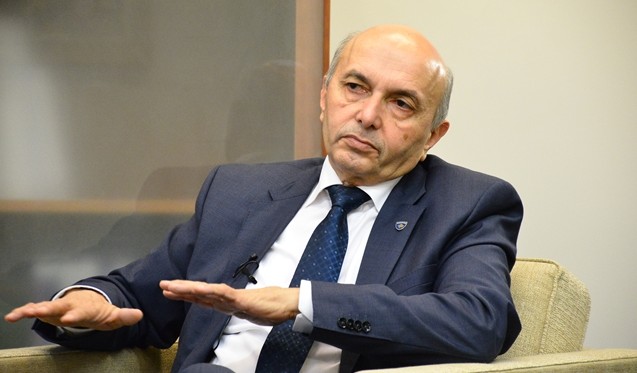
Academician Isa Mustafa (1951), former Prime Minister and former leader of the Democratic League of Kosovo (LDK), in an exclusive interview for BalkanView assesses the current political moment Kosovo is going through, the failure of Albin Kurti’s Vetëvendosje Movement (LVV), as well as the failure of other political forces to form a government—leading the country to early elections at the end of the year. Mr. Mustafa also comments on the support Kurti is giving to the political grouping VLEN in North Macedonia: “Kosovo has neither the comfort nor sufficient capacity to resolve its own internal problems, let alone to interfere in the internal political relations of Albanian parties in North Macedonia or in other areas where Albanians live and operate. Kurti tried this intervention in Albania and failed badly; he tried it in the Preševo Valley; and in North Macedonia I believe he made a major and unforgivable political mistake by openly lining up against the DUI, in effect jeopardizing the achievements of the political, cultural, and democratic emancipation of Albanians there”.
Interview by: Seladin Xhezairi
BV: Professor Mustafa, on December 28 Kosovo is heading to early elections. The reason is known, but from the outside it appears that the political class in Pristina has failed a crucial test—something that could prove very costly for the country. Where do you see the roots of this failure?
ISA MUSTAFA: The causes are different, but they converge. There has been a collapse of trust among political actors to the lowest level since the post-war period, as well as the ambitions of the Vetëvendosje Movement to secure a majority in the general parliamentary elections. LVV failed to secure half a million votes to govern Kosovo on its own without a coalition. It wasted a great deal of time manipulating the candidacy for Speaker of the Assembly—around 50 parliamentary sessions—and later by opposing the election of one of the Assembly’s deputy speakers from non-majority communities. Meanwhile, the Constitutional Court, at the request of MPs from other parties, issued two rulings to bring the process back onto constitutional tracks.
BV: This is somewhat strange: in the early 1990s, the LDK and other forces managed to establish what was called a parallel system against the one imposed by the Milošević regime, whereas now there has been a failure to create institutions after the February elections. Yes, Albin Kurti failed—but so did the other political forces. Was it a lack of will, or an inability?
ISA MUSTAFA: In the 1990s there was nationwide mobilization, led by President Ibrahim Rugova, to oppose Serbia. Today, we see that the past is quickly being forgotten, along with the commitment to build a state of citizens—economically developed and emancipated—modeled on Western democracies. The fate of the state is being gambled. The VV party, which emerged first in the elections, showed no real interest in forming a government. Although it claimed to have the votes, it was proven that it did not—or, better put, that it was not interested in concluding the process. The then-opposition parties—PDK, LDK, and AAK—also lacked the confidence to form a government, which would certainly have been fragile; therefore, in most cases, their justifications for not attempting to establish a government were not sufficiently convincing.
BV: From your experience working with the leader of VV, do you think Mr. Kurti has learned any lessons from the way he treats his political opponents? I am referring to his manner of communication with you about a decade ago, and more recently to his labeling of political opponents with insults.
ISA MUSTAFA: Kurti and VV have a history of very violent political actions—not only harsh and degrading public language. Worse still, he has found a substantial base of voters who support such behavior and language. This support should be more worrying than the verbal attacks themselves, or than tear gas canisters, stones, and Molotov cocktails thrown against institutions, individuals, and private property. Through such behavior, VV managed to present itself as a “government of hope,” and that hope ended in a deep economic and social crisis, in sanctions from the European Union, and in a deterioration of relations with the United States.
BV: To be brief: do you think that on December 28 Kosovo will cross the Rubicon of uncertainty—if not political crisis—especially considering that presidential elections are expected in the spring?
ISA MUSTAFA: Uncertainty will persist as long as we promote and prefer populist policies, and as long as—rather than focusing on economic and social development—we remain hostage to policies tied to Serbia and the Serbs. Institutions may be established, and the results of December 28 may change to the extent that political awareness changes after a lost political and economic year.
BV: Professor, what are the most pressing challenges and problems Kosovo faces today? Let us start with the internal ones.
ISA MUSTAFA: Currently, the greatest challenge is the emigration of citizens, especially young people, from Kosovo. This is a sad indicator that young people no longer believe in the prospects offered by the Kosovar state for their future—whether in terms of employment, development, education, or security—because political leadership speaks more about war than about the basic needs of citizens. Businesses see no long-term security for development and are attempting to relocate to neighboring countries. The quality of education is low when measured against international standards.
BV: And the external challenges? How can the dialogue with Serbia be unblocked and moved forward, and how can the currently cold relations with the United States and the EU be “warmed up”?
ISA MUSTAFA: Concluding the dialogue with Serbia first and foremost requires internal dialogue, which would result in agreement between government and opposition on the objectives and outcomes of this process. At the center should be mutual recognition, with the preservation of territorial integrity and sovereignty as preconditions. The terrain is not very favorable for Kosovo, because EU policy appears asymmetric—amnestying Serbia’s unconstructive, hostile, and destabilizing behavior while pointing the finger mainly at Kosovo. The dialogue can succeed with substantive involvement from the United States. However, this involvement requires an active role from the Government and all Kosovar institutions.
BV: Let us talk briefly about the efforts of the VV leader, Albin Kurti, who as Prime Minister of Kosovo took part in two or three election cycles supporting an Albanian political grouping in North Macedonia, openly opposing the Democratic Union for Integration (DUI) and Ali Ahmeti. Does Kosovo really have the comfort to interfere in the political organization of Albanians in this neighboring country—an intervention that has produced divisions rather than unity?
ISA MUSTAFA: Kosovo does not have the comfort nor sufficient capacity to resolve its own internal problems, let alone to interfere in the internal political relations of Albanian parties in North Macedonia or in other areas where Albanians live and operate. Kurti tried such intervention in Albania and failed badly; he tried it in the Preševo Valley; and in North Macedonia I believe he made a major and unforgivable political mistake by openly aligning against the DUI, thereby endangering the achievements of the political, cultural, and democratic emancipation of Albanians there.
BV: Finally: as a former prime minister and a keen observer of developments in Kosovo and the region, do you see light at the end of the tunnel—better days for Kosovo and the region—given concerns that the Balkans remain a “powder keg”?
ISA MUSTAFA: The six Western Balkan countries—Kosovo, Albania, Montenegro, North Macedonia, Bosnia and Herzegovina, and Serbia—with around 17 million inhabitants and an average GDP of about €9,000 per capita, are still far from the level of development and living standards of the EU average, as well as those of Central and Eastern European countries that completed their transition and became EU members. The consequences of the wars at the end of the last century have left deep scars and have proven to be limiting factors in their economic and political consolidation. The economies of these countries suffer from low competitiveness in regional and European markets, high levels of informal economy, and corruption. Kosovo has lost—and continues to lose—a great deal of time and energy stabilizing relations with Serbia. I do not believe any of these countries have the potential to be a “powder keg” for European stability, but some of them remain trapped in the mindset of the past.
BV: What needs to be done for this to truly change?
ISA MUSTAFA: We should take inspiration from the Baltic states and Central European countries to chart a faster path of political, economic, and democratic transition. Economic policies that stimulate the private sector, increasing institutional efficiency, and strengthening the rule of law are key factors in accelerating this process—both in Kosovo and across the region. We must accept that, even if we wish otherwise, we are not sufficiently important nor do we have the capacity and expertise to waste time on grand geopolitical themes, which belong to the world’s major economic and political powers.