


Europe’s trade machine is sputtering again—and the tremors are being felt most acutely on its periphery.
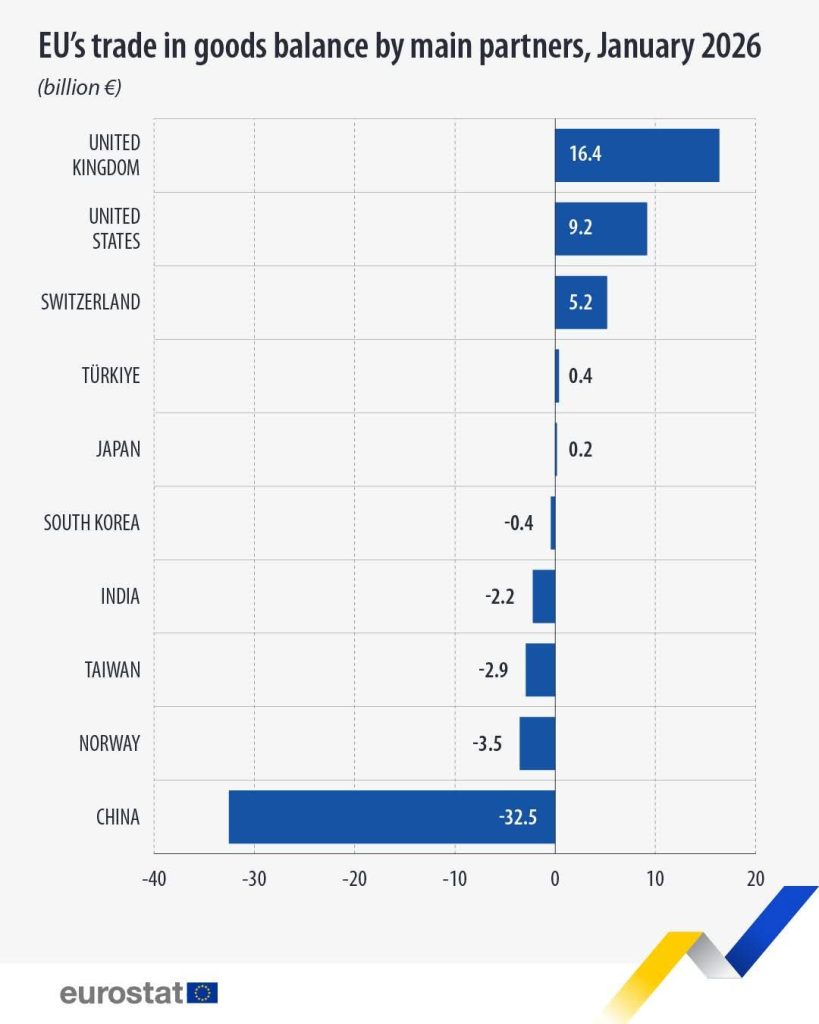
The latest figures for January 2026 show the euro area slipping into a modest goods deficit of €1.9bn, while the European Union as a whole posted a wider shortfall of €5.9bn. On the surface, this is hardly dramatic. Europe has run far larger imbalances before. But the composition of the shift—and its timing—tell a more troubling story, especially for the Balkans.
A slowdown in Europe’s industrial core
The immediate culprit is a sharp deterioration in Europe’s industrial surplus. The once-reliable machinery and vehicles sector—long the backbone of German and Central European exports—has seen its surplus collapse. In the euro area, it fell from €13.2bn in December to just €1.6bn in January. Chemicals, another pillar of European competitiveness, have also weakened significantly.
Exports and imports are both down year-on-year, suggesting not a surge in foreign demand but a broader cooling of global trade. Europe is exporting less and importing less—a classic sign of stagnation rather than rebalancing.
Energy offers the only bright spot. Lower import costs have reduced the bloc’s energy deficit. But this improvement reflects softer prices and demand, not structural strength.
Why the Balkans should worry
For the Balkans, this matters enormously. The region’s economies are deeply entangled with the EU’s industrial supply chains, particularly those centred on Germany, Italy and Austria.
Countries such as Serbia, North Macedonia and Bosnia and Herzegovina have built their export models around low-cost integration into European manufacturing—especially automotive components, wiring systems and basic industrial inputs. When Europe’s machinery sector slows, Balkan factories feel it almost immediately.
The January data hint at precisely such a transmission. A contraction in EU exports of machinery and vehicles suggests weakening external demand for finished goods. That, in turn, reduces orders along the supply chain—often hitting Balkan subcontractors first.
Trade dependence without buffers
Unlike richer EU members, Balkan economies lack strong domestic demand to cushion such shocks. Their growth models are export-led but narrowly concentrated. In North Macedonia, for instance, industrial zones dominated by foreign investors account for a large share of exports, but generate limited spillovers into the broader economy. When orders fall, the adjustment is swift and painful.
Serbia, though somewhat more diversified, remains heavily reliant on EU markets. Meanwhile, Albania—less industrialised—faces a different risk: weaker European demand for textiles and raw materials, alongside reduced remittances and tourism flows if the slowdown deepens.
A shifting external landscape
There is another, subtler shift underway. Trade with the United States has dropped sharply, with EU exports down nearly 28% year-on-year in January. If sustained, this could signal a reorientation of global trade patterns—or rising frictions. Either way, smaller economies tied to European exports will have little control over the fallout.
At the same time, the EU’s large deficit with China persists, underscoring Europe’s continued dependence on imports of industrial inputs and consumer goods. For Balkan producers hoping to move up the value chain, this is a double constraint: weak demand in the West and intense competition from the East.
From convergence to vulnerability
For years, the Balkans have been framed as a convergence story—gradually catching up with Western Europe through integration into its markets. But the latest data highlight the fragility of that model.
Integration without diversification creates exposure. When Europe slows, the Balkans do not merely follow—they amplify the cycle. A dip in German exports becomes a sharper contraction in Balkan output; a mild EU trade deficit can translate into lost jobs in Skopje or Kragujevac.
What comes next
The immediate outlook depends on whether January’s figures mark a temporary dip or the start of a broader downturn. Seasonal adjustments suggest some resilience, with modest trade surpluses still visible in smoothed data. But the direction of travel is clear: Europe’s export engine is losing momentum.
For Balkan policymakers, the lesson is uncomfortable but familiar. Relying on Europe is inevitable; relying only on Europe is risky. Diversification—towards services, regional trade and higher-value manufacturing—remains more aspiration than reality.
Until that changes, the Balkans will remain what they have long been: Europe’s economic echo chamber, where every shift in the centre reverberates more loudly at the edges. (Balkan View)