


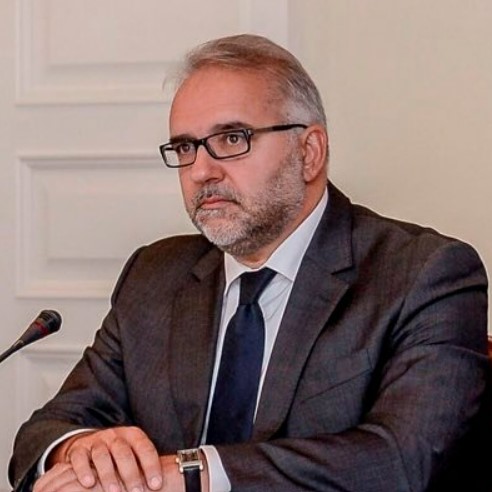
Dragan Tilev, the former state secretary for European affairs, says North Macedonia still maintains a higher level of alignment with EU law compared to Albania but warns that without a political solution and faster reforms, the country risks falling further behind in the EU accession process.
BALKANVIEW: Until September 2024, Albania and North Macedonia were advancing together in the EU accession process. What are the main reasons for their separation today?
Dragan Tilev: We indeed diverged. We were linked as a region, but with Albania, we were closer in the process because we followed the same steps. For a long time, we were far ahead, but Albania focused more on the process and devoted all its resources to it. We had the same priority until Greece blocked our progress over the name issue, and later, Bulgaria, for historical reasons. Until June 19, 2022, we were moving together with Albania; we jointly held the first intergovernmental conference, officially starting negotiations together.
The difference was that Albania held a full intergovernmental conference, while we had a political intergovernmental conference. The political conference was merely a political opening, not substantive. This resulted from the Bulgarian objection, which at the time was withdrawn to allow negotiations, but under the condition that constitutional changes required by the Second Protocol with Bulgaria be made. Bulgaria used this moment to set conditions, while the European Commission found a formula for a political opening of negotiations, based on the new methodology. On the same day, we and Albania held a joint intergovernmental conference, but Albania had a substantive one, and we had a political one.
We then began the screening process together and participated in all sessions. We started in 2022 and completed screening in 2023 as the first step toward accession negotiations. The split occurred in October 2024 when Albania opened the first cluster after meeting the prerequisites — namely the rule-of-law and public administration reform benchmarks. From there, Albania moved rapidly, using the positive aspects of the new methodology, and within 12 months opened all six clusters and completed all 33 chapters.
BALKANVIEW: How much of North Macedonia’s delay is due to the Bulgarian veto and how much to insufficient domestic reforms?
Dragan Tilev: This divergence is purely political, stemming from Bulgaria’s request for constitutional changes. This is a bilateral issue originating from Protocol 2, which mentions opening the constitution and including the Bulgarian community in our preamble. When Protocol 2 was transferred into the EU Council conclusions and the negotiating framework was approved on June 18, 2022, this bilateral issue became a European condition. The European condition acts as a political benchmark — until it is fulfilled, the “Foundations” cluster cannot be opened. Albania did not have such a prerequisite and advanced at unprecedented speed.
BALKANVIEW: Is Albania truly “ahead” of North Macedonia, or is it more a matter of political perception?
Dragan Tilev: If measured by reforms — specifically alignment of laws with EU legislation — even though Albania is ahead in negotiations, we are more aligned legally. But the real measure is whether we have economies, institutions, and legislation closer to the EU. Since Albania opened all clusters and chapters, the negotiation process will accelerate its reforms. The European Commission’s report later this year will likely show them at the same or higher level than us in reform implementation. Our advantage can remain only if we accelerate domestic reforms, regardless of the negotiation start.
BALKANVIEW: North Macedonia also had benchmarks, such as administration reforms, anti-corruption measures, and minority action plans, but these haven’t been fulfilled despite no Bulgarian blockage.
Dragan Tilev: Before that, our precondition is opening the Constitution, changing the preamble and two related articles — a political prerequisite.
BALKANVIEW: But Bulgaria wasn’t an obstacle for the benchmarks and action plans, correct?
Dragan Tilev: The benchmarks are ready; I participated in drafting them. I coordinated the rule-of-law benchmark. The minority rights action plan — as defined in the negotiating framework — was developed with Bulgaria’s insistence and needed discussion with minority representatives. This happened, but the process isn’t complete due to some Bulgarian objections. The public administration reform benchmark is harmonized with the European Commission. The action plan is part of the rule-of-law benchmark, so the government failed to submit it together with the rule-of-law benchmark, which the Commission uses to confirm the prerequisites for the “Foundations” cluster. Without constitutional changes as a political benchmark, negotiations and the second intergovernmental conference cannot proceed.
BALKANVIEW: Would timely reforms send a strong message of commitment to the EU and put pressure on Brussels to convince Bulgaria to relax its stance?
Dragan Tilev: Screening reports provide a clear overview of each cluster and area. Combined with annual EC reports and the 2024–2027 Reform Agenda, we have a solid base to implement reforms even before opening the first cluster. But these are deep, long-term reforms requiring a positive atmosphere, which is currently lacking. There is frustration among the public, administration, and political elites. This is key to understanding why reforms aren’t progressing even without formal negotiations. Institutions try, but reforms have a cost — you need public support, energy, and a positive climate. The lack of this is why the Reform Agenda shows limited results.
The agenda aligns with previous and current governments and includes six priorities with 137 reforms, each with a cost. Timely reform execution allows fund disbursement, but delays the risk of losing funds. The 12-month “grace period” ended in 2025, and many activities weren’t completed on time. Hypothetically, funds could be released after reforms, but without ready projects, they won’t be used. Other states could benefit from our unutilized funds if they implement reforms more efficiently.
BALKANVIEW: What is the risk if the gap between political rhetoric and real reform outcomes continues?
Dragan Tilev: It affects all levels. Political authorities emphasize EU integration as a strategic priority, but speaking about it is not the same as implementing required reforms. Reforms need an environment that pressures both politicians and the administration.
BALKANVIEW: Does the identity-based nature of the dispute with Bulgaria demotivate citizens, especially the ethnic Macedonian majority?
Dragan Tilev: No other regional dispute resembles this. Bulgaria’s rhetoric on our language, history, and minorities is unique, like Greece’s name dispute. Identity issues are being “attacked” by neighbors. Without identity recognition, the state faces survival challenges.
BALKANVIEW: How does North Macedonia compare with Albania on environmental issues?
Dragan Tilev: According to EC reports, our legislation is closer to Montenegro’s standards, better than Serbia and significantly ahead of Albania’s. Over 50% of our legislation is harmonized with EU standards. But legislation alone is insufficient; implementation capacity and enforcement are key.
BALKANVIEW: Could geopolitical actors like Russia or China exploit delays to increase influence?
Dragan Tilev: North Macedonia is a NATO member and has strategic agreements with the U.S., providing security safeguards. However, slow EU integration can create openings for foreign influence over time, possibly via proxies like Serbia.
BALKANVIEW: Is there a risk of inter-ethnic tensions if Albania joins the EU by 2030 while North Macedonia remains blocked?
Dragan Tilev: The probability is very low but not zero, given unresolved minority rights issues under the Ohrid Framework. A unitary NATO member with constitutional solutions could catch up with Montenegro, Albania, Ukraine, and Moldova. EU accession could also benefit North Macedonia economically due to its ties with Albania.
BALKANVIEW: What short-term steps could unblock EU integration — a pro-European government in Bulgaria, EU decision-making changes, or…?
Dragan Tilev: Bulgaria has had unstable governments for years; demands remain consistent regardless of government. Moving from unanimity to qualified majority voting in the EU could help, but constitutional changes in North Macedonia are the first hurdle. If Bulgaria guarantees that identity issues won’t block further integration, constitutional amendments could be approved.
BALKANVIEW: As a veteran EU integration expert, do you see a geostrategic urgency for EU enlargement in the Balkans?
Dragan Tilev: Since Russia’s 2022 invasion of Ukraine, it’s clear Europe must fill the strategic gap in the Western Balkans. The EU is interested, but a unanimous agreement on timing and method is lacking. The chance of a country joining now is higher than before. Completion of accession requires unanimity among member states. 2027 is frequently cited as a target year, before French presidential elections in 2028, when the EU is relatively stable.