


By BV Team
As the Western Balkans move closer to a pivotal moment in their EU integration journey, the Berlin Process continues to serve as a vital bridge between the region and its European partners. This year’s Summit in London brought renewed attention to the United Kingdom’s role in fostering dialogue and cooperation after Brexit. To explore how these dynamics are shaping regional priorities, BV spoke with Dr. Andi Hoxhaj, Lecturer in Law and expert on the Balkans at King’s College London, who helped facilitate discussions between policymakers, civil society, and academia ahead of the Summit. In this interview, Dr. Hoxhaj reflects on the UK’s evolving engagement with the Western Balkans, the future of the Berlin Process, and why 2030 could mark a turning point for EU enlargement.
BV: How did the discussions at King’s College London contribute to shaping the agenda or priorities of the Berlin Process Summit?
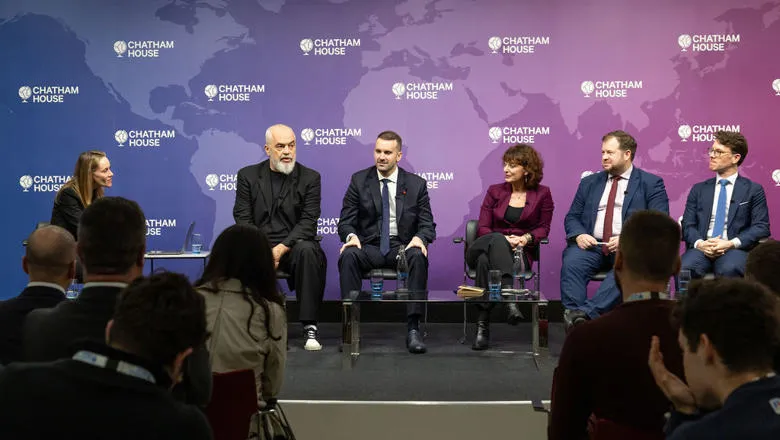
Andi Hoxhaj: We wanted to make sure that the discussions around the Summit weren’t limited only to the official agenda. So, we organised a series of side events that brought together voices from civil society, the media, academia, and the private sector. Our aim was to create an open space for dialogue with key British policymakers and leaders from the Western Balkans.
To make this happen, we partnered closely with two of the UK’s most respected and oldest independent policy institutes — the Royal Institute of International Affairs (known as Chatham House), and the Royal United Services Institute for Defence and Security Studies (RUSI).
Through these collaborations, we were able to raise several important policy issues that might not have been fully addressed during the main Summit — particularly topics like education and human rights — and ensure they received the attention they deserve.
BV: What makes this year’s London Summit of the Berlin Process particularly significant for EU–Western Balkans relations?
Andi Hoxhaj: The Summit in London was particularly important because of the UK’s role as both host and agenda-setter, with the Berlin Process continuing to serve as an essential forum for the UK to engage with the Western Balkans. This year’s meeting carried added significance under the Labour Government, which came to power in 2024 and is seeking to strengthen relations with Europe. One of the key themes of the discussions was regional security — specifically, how to help transform the Western Balkans from security consumers into security providers for Europe, in light of Russia’s ongoing aggression and hybrid warfare across several European countries, including those in the Western Balkans.
BV: How does the UK’s involvement after Brexit fit within the Berlin Process framework, which was initially an EU-driven initiative?

Andi Hoxhaj: The Berlin Process was initially established as an informal forum to support and feed into the EU integration agenda. At that time, the UK was still an EU member — a fact that, some might argue, puts the UK in a somewhat awkward position today. Nevertheless, the Berlin Process was originally intended to last only five years, yet next year will mark its 12th edition. Over time, it has evolved into an annual summit where participating countries can also address pressing issues that are not necessarily linked to EU accession. This year’s discussions, for example, focused on topics such as migration management and countering hybrid warfare.
For the UK, the Berlin Process remains an important platform for engaging with the Western Balkans on shared interests and priorities on an annual basis.
BV: With enlargement fatigue still present in parts of the EU, what realistic timeline do you see for Western Balkan countries joining the Union?
Andi Hoxhaj: I think that by 2030 we could see some of the Western Balkan’s countries — particularly Albania and Montenegro — joining the European Union. This is partly because the EU is looking for a positive narrative that demonstrates the Union’s strength and continued expansion. It is also keen to lay the groundwork for welcoming larger countries like Ukraine as future members once the war ends and the country begins its recovery. Under these geopolitical circumstances, some of the Western Balkan’s states may now be closer than ever to joining the EU — presenting a golden opportunity that should not be missed.
BV: How can the Berlin Process help maintain reform momentum in the region, given the slow pace of accession negotiations?
Andi Hoxhaj: The Berlin Process is a useful framework for addressing bilateral issues, particularly between member states, which can ultimately support their EU accession process. However, the pace of accession is not always directly linked to meeting the technical criteria — political considerations also often determine the speed of progress. In the long term, the Berlin Process should be transformed into a format that brings together the European Union and the Western Balkans directly, as this could provide stronger momentum and more concrete input to advance EU accession.
BV: One of the summit’s focuses was regional connectivity and security. How effectively are the Western Balkan countries cooperating on these fronts?
Andi Hoxhaj: Issues of regional connectivity remain a major challenge. Despite the region’s geographical proximity, transportation links are still limited, and in some cases, it is quicker and easier to travel to certain EU member states than between countries within the Western Balkans. Ambitious plans to connect the region through railways and highways exist, but progress has lagged behind due to insufficient investment, which remains a key area for improvement.
Regarding security, the region is still in the early stages of integration. While about half of the Western Balkans states are NATO members and cooperation between them is good, achieving deeper collaboration will require building mutual trust and strengthening infrastructure. Nevertheless, there are common goals that can unite the Western Balkans, and finding the right initiatives to enable security cooperation is essential for regional stability.
BV: How do current geopolitical tensions — especially the war in Ukraine — shape the EU’s and the UK’s approach to the Western Balkans?
Andi Hoxhaj: The war in Ukraine has by no means reduced the EU’s focus on the Western Balkans, and in some cases, it has actually helped unblock a number of processes. For example, it facilitated the opening of accession talks with Albania and North Macedonia, as well as progress toward granting Bosnia and Herzegovina EU candidate status and opening accession discussions. However, on the Kosovo-Serbia dialogue, there has been no tangible progress, due both to internal political issues, including elections in Kosovo and Serbia, and to growing distrust between the parties.
The UK, meanwhile, is further developing its policy toward the Western Balkans, aiming to strengthen strategic partnerships. However, much of this engagement focuses on migration management, which remains a key policy concern for the UK government under pressure from voters. As a result, much of the UK’s foreign engagement with the region has been shaped by efforts to address migration-related issues.
BV: In your view, is the Berlin Process evolving into a genuine regional integration mechanism, or does it remain a political dialogue platform?
Andi Hoxhaj: I believe the Berlin Process remains largely a potential dialogue platform, and it should continue to serve as such, as it provides a valuable forum to address and discuss bilateral issues on a wider platform on an annual basis. There is no doubt that the Berlin Process has brought the region closer together — before it, some Western Balkans leaders had not held official visits with each other for more than seven decades, and that achievement deserves to be acknowledged.
BV: How important is the Common Regional Market initiative for the region’s economic future and for EU readiness?
Andi Hoxhaj: The Common Regional Market is a valuable initiative to prepare the region for economic cooperation and to help countries learn to implement EU rules. However, I believe it is time-consuming, and it might be more effective for any EU candidate country to join the EU Single Market once accession talks begin, rather than participating in a parallel regional market. After all, the ultimate goal is EU membership, and sometimes these regional initiatives can appear to simply shift the goalposts for accession.
BV: What role can the UK play in supporting innovation, education, and investment in the Western Balkans beyond the EU framework?
Andi Hoxhaj: The UK can and should play a greater role in education, as it is an area that is generally non-controversial when it comes to cooperation, unlike migration or security. The UK has also planned to rejoin the EU Erasmus scheme and participate in the EU Research Council. However, one aspect missing from the Berlin Process on education was the 2017 initiative to establish a Regional Academy of Science to support education and innovation — an effort that the UK strongly backed. Unfortunately, it never fully materialized, and ensuring that such initiatives receive greater attention should be a priority for the next edition of the Berlin Process.
BV: Many Western Balkan countries continue to struggle with corruption and weak institutions. Has the Berlin Process made a tangible impact in these areas?
Andi Hoxhaj: In the past, the Berlin Process has made some pledges to address corruption and strengthen the rule of law. However, some countries have viewed these issues as outside the forum’s scope, believing they should be left to the EU accession process. In short, the Berlin Process has not had a tangible impact in these areas. Nevertheless, it can and should serve as a platform for sharing experiences and best practices on how to address these challenges. Framing it this way could make the forum more engaging and inviting for Western Balkans countries to discuss these critical issues.
BV: Where do you see the Berlin Process heading in the next five years?
Andi Hoxhaj: Ideally, in the next few years, the countries of the Western Balkans will have joined the European Union, and the Berlin Process will have achieved its original purpose. Nevertheless, I believe that the format can and should remain primarily political, allowing countries to address bilateral issues. Having an annual summit helps set a timetable for addressing outstanding matters or responding to issues as they arise. Nordic countries have similar initiatives when they meet, and perhaps in the future, the Berlin Process could become a biennial event once some of the countries have joined the Union.
BV: Finally, what message should the London Summit send to young people in the region who are losing faith in the EU path?
Andi Hoxhaj: Young people have every reason to feel uncertain given the current geopolitical developments. However, one thing is clear: the European Union is more than just a goal for countries undergoing transition from post-communist or post-conflict contexts to democratic and prosperous societies. While this process will still take time, it is crucial that leaders involve young people and make them feel part of the journey — giving them a voice and the opportunity to contribute to improving the region.
A positive development is that the next edition of the Summit will be held in the region, in Montenegro. Since the host country can help set the agenda and themes for the Summit, they should ensure that youth are at the centre of the discussions next year and that their needs and perspectives are meaningfully addressed.