


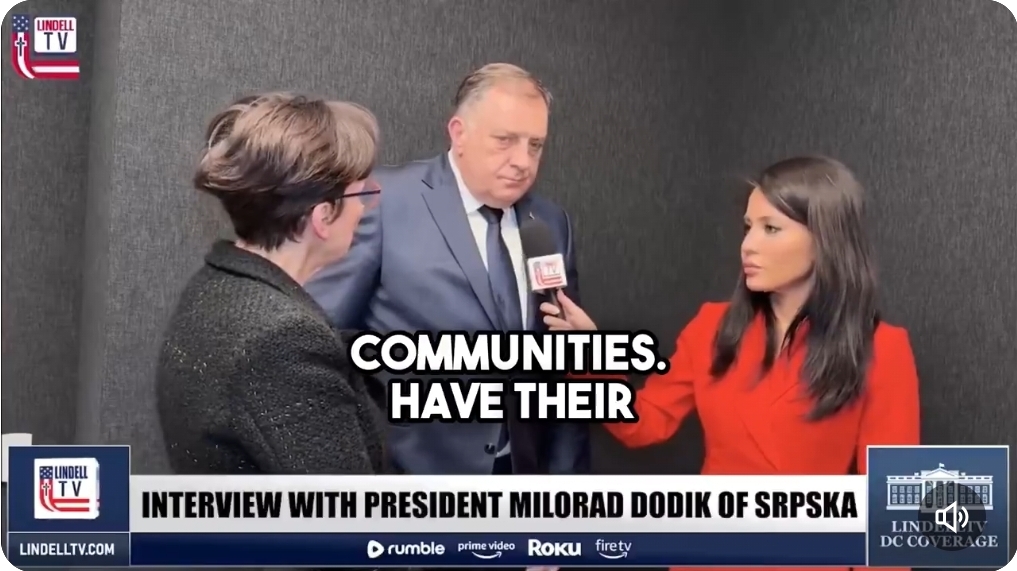
Bosnian Serb leader Milorad Dodik, who has been sanctioned by the United States and convicted by a Bosnian court, said in an interview with a U.S. conservative television outlet that independence for the Serb-dominated Republika Srpska (RS) entity remained his ultimate political goal, repeating claims that have drawn strong criticism from Bosniak leaders and Western governments.
Dodik, president of Republika Srpska, spoke to Lindell TV, a U.S.-based outlet owned by businessman and Donald Trump ally Mike Lindell. During the interview, conducted with the assistance of a translator, Dodik accused Bosniaks, Bosnia’s Muslim population, of discrimination against Serbs and made a series of historically and politically contentious claims.
Dodik was introduced in the interview as “president of Republika Srpska” and spoke in the Bosnian language, with questions translated into English.
“We cannot function like this anymore,” Dodik said, arguing that Bosnia and Herzegovina was being forcibly centralised under pressure from Europe. “To preserve the Serbian community, we must have an independent country.”
He claimed that Serbs were being marginalised in areas where Bosniaks are a majority and alleged that property and churches were being confiscated, accusations that Bosniak officials have repeatedly denied.
Dodik also reiterated inflammatory historical claims, accusing Bosniaks of collective responsibility for crimes during World War Two and linking them to Iran and hostility toward Israel and Jews. Historians and international organisations have previously rejected similar claims as inaccurate and inflammatory.
Praise for Trump, criticism of U.S. sanctions
In the interview, Dodik praised U.S. President Donald Trump, calling him “the hope of humanity,” and said he hoped to meet Trump at the White House. He criticised the Biden and Obama administrations for imposing sanctions on him and members of his family.
Dodik said U.S. sanctions had targeted his entire family, including his daughter, describing the measures as unjust and politically motivated.
The United States imposed sanctions on Dodik for undermining the Dayton Peace Accords, which ended Bosnia’s 1992–1995 war, and for corruption-related activities. Washington has repeatedly warned that any attempt by Republika Srpska to secede would violate the Dayton agreement and threaten regional stability.
A fragile post-war state
Bosnia and Herzegovina is a complex state composed of two entities – the Bosniak-Croat Federation and the Serb-dominated Republika Srpska – linked by weak central institutions under the Dayton framework. The arrangement was designed to balance competing ethnic interests following a war that killed around 100,000 people.
Dodik, a long-time dominant figure in Bosnian Serb politics, has for years advocated greater autonomy for Republika Srpska and periodically threatened secession. Western governments and the Office of the High Representative, the international body overseeing Dayton’s implementation, have warned that such moves risk destabilising the Western Balkans.
In recent years, Dodik has intensified his rhetoric amid growing tensions between Bosnia’s entities, while cultivating closer political ties with Russia and nationalist figures abroad. He has also portrayed himself as a victim of Western pressure, framing sanctions and legal action as attacks on the Serb people.
Bosnia’s state-level institutions and Bosniak political leaders have condemned Dodik’s statements, saying they undermine peace and fuel ethnic divisions. The European Union and the United States have reiterated their support for Bosnia’s territorial integrity.