


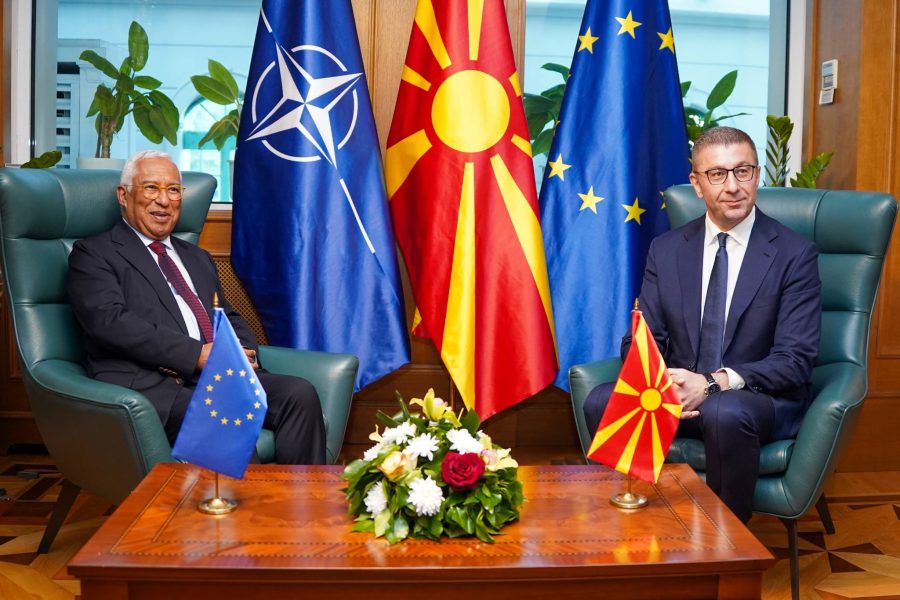
SKOPJE/TIRANA/SARAJEVO/PRISTINA, June 3 (Balkan View) – European Council President António Costa’s week-long tour of the Western Balkans has become the clearest signal yet that the European Union is once again treating enlargement as a strategic priority rather than a distant aspiration.
Traveling through Bosnia and Herzegovina, Albania, North Macedonia, Kosovo, Serbia and Montenegro ahead of the EU-Western Balkans Summit in Tivat on June 5, Costa has delivered a message that combines encouragement with growing impatience: the EU remains committed to enlargement, but candidate countries must now demonstrate results.
The timing of the tour is significant.
Russia’s war in Ukraine, growing geopolitical competition with China, concerns about regional stability and uncertainty surrounding the future security architecture of Europe have transformed enlargement from a largely bureaucratic process into a geopolitical necessity.
“My second visit to the Western Balkans sends a clear signal: the EU’s commitment to the region is real, as real as the opportunity for enlargement,” Costa said at the beginning of his tour.
Behind the diplomatic language lies a broader reality: Brussels increasingly views the integration of the Western Balkans not merely as a policy objective but as a strategic investment in Europe’s security and stability.
Yet Costa’s visits also revealed a region moving at dramatically different speeds, with some countries advancing rapidly toward membership while others remain trapped in political disputes and institutional paralysis.
Enlargement returns to the center of EU strategy
For much of the last decade, EU enlargement had effectively stalled.
Although all six Western Balkan partners declared EU membership their strategic objective, the process was overshadowed by internal EU crises, Brexit, migration pressures, the COVID-19 pandemic and growing enlargement fatigue among member states.
The Russian invasion of Ukraine fundamentally changed that calculation.
European leaders increasingly fear that prolonged uncertainty in the Western Balkans could create opportunities for external influence from Russia, China, Turkey and Gulf countries.
As a result, enlargement has returned to the center of Brussels’ geopolitical thinking.
Former European Commission Vice-President Věra Jourová summarized the shift bluntly this week.
“I see that we need them to join more than they need Europe,” she said.
This changing strategic environment explains why Costa’s tour has received unusual political attention in Brussels.
Senior EU officials describe the current moment as a rare window of opportunity that both the EU and the region must seize.
Whether the Western Balkans can capitalize on that opportunity remains uncertain.
Albania emerges as the region’s fastest-rising candidate
If Costa’s tour had a clear success story, it was Albania.
During his visit to Tirana, Costa openly praised the country’s progress and highlighted the recent Intergovernmental Conference that confirmed Albania had fulfilled the interim benchmarks under Cluster 1, known as “Fundamentals.”
The achievement is considered one of the most important milestones in the accession process because it covers rule of law, judicial reforms, democratic institutions and anti-corruption measures.
Costa described the development as evidence that EU member states recognize Albania’s commitment to reforms.
“This shows that member states have understood and appreciated Albania’s commitment to continue moving forward on its path toward EU membership,” he said.
The message reflected a growing perception in Brussels that Albania has become one of the most credible enlargement candidates in the region.
EU diplomats increasingly point to Albania’s judicial vetting process, anti-corruption reforms and relatively stable political direction as examples of sustained commitment to the accession agenda.
While significant challenges remain, Albania is now frequently mentioned alongside Montenegro as the region’s leading candidate for future membership.
The country’s gradual integration into EU mechanisms, including SEPA euro payments, roaming initiatives and increased access to the single market, is already providing tangible benefits before full membership.
Montenegro remains the frontrunner
Montenegro continues to hold the strongest position in the enlargement race.
The fact that Friday’s EU-Western Balkans Summit is being hosted in Tivat is itself symbolic.
Among all Western Balkan countries, Montenegro has opened and provisionally closed the highest number of negotiating chapters and remains the most advanced accession candidate.
Several European diplomats privately acknowledge that Montenegro could become the next EU member state if current reform momentum continues.
For Brussels, Montenegro represents an opportunity to demonstrate that enlargement remains a credible process capable of delivering concrete outcomes.
After years of skepticism about the EU’s willingness to expand, Montenegro’s eventual accession would serve as proof that reforms are rewarded.
The symbolism is particularly important because many countries in the region have spent nearly two decades waiting for membership without seeing significant movement.
North Macedonia remains trapped in a political deadlock
The contrast with North Macedonia could hardly be sharper.
Costa’s visit to Skopje produced no breakthrough and no new proposal for overcoming the country’s stalled accession process.
Instead, he reiterated Brussels’ long-standing position that constitutional amendments agreed under the 2022 negotiating framework remain a prerequisite for moving forward.
“What has been agreed is agreed,” Costa stated.
The phrase echoed previous messages from European officials and signaled that Brussels has no intention of reopening the compromise reached four years ago.
For Prime Minister Hristijan Mickoski, however, the political challenge remains immense.
His government came to power promising that constitutional changes would not proceed without guarantees that Bulgaria would refrain from introducing additional demands in the future.
The problem is that such guarantees are virtually impossible within the EU’s institutional framework.
Any member state retains the right to block progress during future stages of accession.
Neither the European Commission nor the European Council can legally prevent individual member states from exercising that right.
As a result, the dispute has become less about constitutional amendments themselves and more about trust.
Skopje seeks political certainty.
Brussels cannot provide it.
This fundamental mismatch continues to block progress despite broad rhetorical support for enlargement.
North Macedonia therefore remains perhaps the most striking example of how bilateral disputes can undermine the EU’s merit-based accession principle.
Bosnia and Herzegovina faces mounting pressure
Costa delivered some of his strongest warnings in Sarajevo.
Meeting members of Bosnia and Herzegovina’s Presidency and government officials, he emphasized that the country is approaching a critical moment in its European path.
According to Costa, Bosnia must urgently adopt two remaining laws related to the judiciary, appoint a chief negotiator and implement commitments under the EU Growth Plan.
Failure to do so carries substantial financial consequences.
Bosnia has already lost €108 million in EU funding, while an additional €373 million remains at risk.
“Do not miss this opportunity,” Costa warned.
The warning reflects growing frustration in Brussels over Bosnia’s inability to translate candidate status into meaningful reform progress.
Political fragmentation, ethnic divisions and institutional paralysis continue to slow decision-making.
Particular concern remains focused on tensions involving the leadership of Republika Srpska and recurring challenges to the authority of state institutions.
For many European officials, Bosnia has become a test of whether the country’s political elites are genuinely committed to European integration.
Kosovo still faces structural obstacles
Costa’s visit to Pristina underscores the EU’s effort to keep Kosovo engaged despite persistent challenges.
Unlike other Western Balkan partners, Kosovo remains classified only as a potential candidate.
The main obstacle remains the fact that several EU member states do not recognize Kosovo’s independence.
This creates a unique situation in which Kosovo’s accession path depends not only on reforms but also on unresolved questions of international recognition.
Costa’s meetings with acting President Albulena Haxhiu, Prime Minister Albin Kurti and opposition leaders are expected to focus on both EU reforms and regional stability.
While Brussels remains committed to Kosovo’s European perspective, the absence of consensus among member states continues to complicate progress.
Serbia’s balancing act continues
Costa’s upcoming stop in Belgrade will likely be among the most closely watched stages of his tour.
Serbia remains one of the region’s largest and most influential countries, yet its relationship with the EU has become increasingly complex.
Although Belgrade formally supports EU membership, concerns persist over its close political ties with Russia and China.
Brussels has repeatedly urged Serbia to align more closely with EU foreign policy positions, particularly regarding sanctions against Russia.
At the same time, European leaders recognize that Serbia remains central to regional stability.
The challenge for Brussels is maintaining pressure for reforms without pushing Serbia further away from the European path.
Ukraine changes the enlargement debate
An important theme running through Costa’s tour is the growing impact of Ukraine on enlargement policy.
As Kyiv pushes for accelerated EU integration following Russia’s invasion, European institutions are being forced to reconsider how enlargement should function in a rapidly changing geopolitical environment.
German Chancellor Friedrich Merz recently proposed an intermediate form of associate membership for Ukraine.
The idea was quickly criticized by Kyiv and received only cautious reactions in Brussels.
Nevertheless, the debate itself reveals growing recognition that traditional enlargement mechanisms may not be sufficient for current geopolitical realities.
Western Balkan governments are watching these discussions closely.
Many fear that Ukraine could receive preferential treatment despite having begun its accession journey much later.
European officials insist that every candidate will continue to be assessed according to merit.
Yet concerns about unequal treatment remain widespread throughout the region.
Tivat summit will test EU credibility
The EU-Western Balkans Summit in Montenegro on June 5 will bring together most EU leaders alongside leaders from Albania, Bosnia and Herzegovina, Kosovo, Montenegro, North Macedonia and Serbia.
The meeting is expected to focus on security, economic integration, connectivity, energy cooperation and enlargement.
Few observers expect major announcements.
The summit’s significance lies more in symbolism than in immediate policy outcomes.
It will serve as a test of whether the EU can translate its renewed political commitment into concrete progress.
For the Western Balkans, the central question is no longer whether the EU supports enlargement.
Costa’s tour has answered that clearly.
The more difficult question is whether the region’s leaders can overcome domestic divisions, implement reforms and build the political consensus necessary to take advantage of a moment that many in Brussels describe as the most favorable enlargement environment in more than a decade.
As the summit approaches, one reality has become increasingly clear: the Western Balkans are no longer moving toward Europe as a single region.
Instead, they are advancing along different tracks, at different speeds, with very different prospects.
The challenge for both Brussels and the region will be ensuring that those differences do not become permanent.