


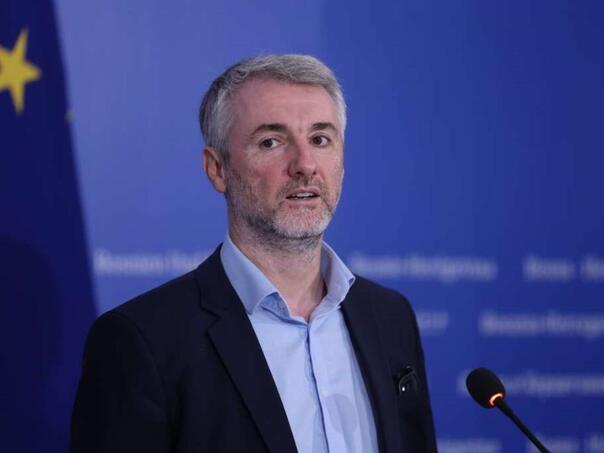
Bosnia and Herzegovina’s communications and transport minister Edin Forto accused coalition parties HDZ BiH and the Alliance of Independent Social Democrats (SNSD) on Thursday of deliberately slowing the work of the state government until the next elections.
Speaking after a session of the Council of Ministers, Forto said discussions with Finance Minister Srđan Amidžić, Foreign Trade and Economic Relations Minister Staša Košarac and Council of Ministers Chair Borjana Krišto led him to conclude there was a political agreement to delay major decisions.
“I will make a political statement that is unequivocal for me after hearing the discussions today – there is an agreement between HDZ and SNSD that nothing should be done until the elections,” Forto said.
He expressed frustration over the slow progress in implementing the European Union’s Growth Plan for Bosnia and Herzegovina, saying four months had passed since the plan was approved while only initial steps were now being taken.
“We waited four months just to assign someone to start working, after which the European Commission will send us the documents,” he said, adding that only minimal steps were being taken to avoid the appearance of a direct blockade.
The EU Growth Plan is expected to bring hundreds of millions of euros in grants to Bosnia, along with a series of reform obligations.
Forto said the Council of Ministers had on Thursday adopted a decision instructing Bosnia’s Finance Ministry to request pre-financing from the European Commission. The commission is expected to send draft texts of two state-level agreements that Bosnia will need to ratify through its full institutional process, including the Council of Ministers, the state presidency and both chambers of parliament.
He also addressed problems faced by Bosnian transport companies after drivers were reportedly denied entry into the Schengen area due to the rule limiting stays to 90 days within a 180-day period.
The Council of Ministers has formed a ministerial working group to seek a solution, which will include representatives of the Foreign Trade Chamber, entity-level chambers of commerce and transport associations.
Forto said he would seek a ministerial meeting with Croatia to discuss the issue, noting that Zagreb had shown “perhaps the most constructive approach” during European Commission working group discussions in Brussels.
Transporters have claimed that Bosnian drivers are sometimes turned back at borders while drivers from other regional countries face fewer restrictions. Forto said he could not confirm those reports but warned that if true they would represent “a major blow” to Bosnia and Herzegovina.