


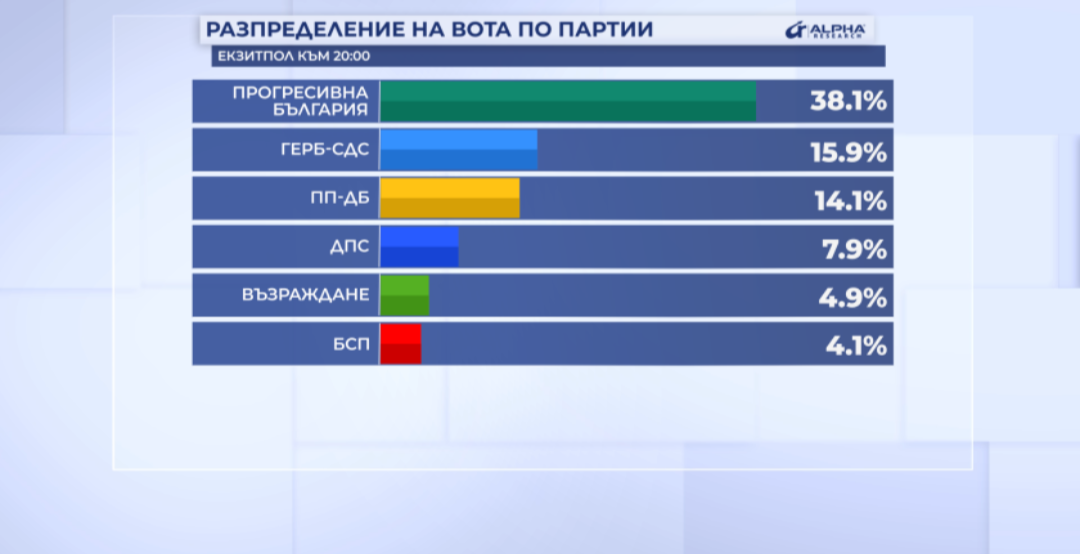
Bulgaria’s parliamentary election points to a potential political shift after years of instability, with exit polls showing a clear lead for the “Progressive Bulgaria” coalition linked to former president Rumen Radev.
According to early projections, the bloc has secured around 38% of the vote, well ahead of the GERB-SDS alliance led by Boyko Borissov and the PP-DB coalition, both of which saw significant declines in support. Six parties are expected to enter parliament, reflecting continued fragmentation despite the emergence of a dominant political force.
The result marks a departure from recent election cycles, where tight competition between the two main blocs produced fragile coalitions, prolonged negotiations and short-lived governments. Bulgaria has now held multiple parliamentary elections since 2021, underscoring deep institutional paralysis and voter fatigue.
While the scale of the lead suggests a stronger mandate for Radev’s bloc, it is unlikely to be sufficient for a single-party majority. This means the key question remains whether the winner can translate electoral momentum into a stable governing coalition, or whether the country will again face difficult negotiations and political deadlock.
The election outcome also reflects shifting voter sentiment. Analysts say support for the new bloc has been driven by frustration over corruption, rising living costs and the prolonged political crisis, as well as by its positioning as an alternative to established political elites.
However, the result also raises broader geopolitical questions. Radev has previously taken more cautious positions on Western policies towards Russia and opposed military support for Ukraine, suggesting that a government led by his allies could adopt a firmer, more nationally focused approach in foreign policy.
For North Macedonia, the implications are particularly significant. A government aligned with Radev is unlikely to soften Bulgaria’s stance on the bilateral dispute in the short term. On the contrary, a strong electoral mandate could reinforce Sofia’s position that constitutional changes and full implementation of bilateral agreements remain prerequisites for progress in EU accession talks.
At the same time, some analysts say a more stable government in Sofia could offer a more predictable negotiating partner. In recent years, frequent elections and short-lived cabinets have made Bulgaria’s policy toward North Macedonia both rigid and inconsistent.
In this sense, the election outcome does not represent a clear breakthrough for Skopje, but rather a shift toward greater clarity about Bulgaria’s position, without necessarily making it easier to resolve outstanding disputes.
More broadly, the results highlight the continued influence of bilateral issues on the European Union’s enlargement process, where national disputes remain a key obstacle.
Domestically, the vote signals a desire among Bulgarian voters for political consolidation after years of fragmentation. Whether this will translate into stability, however, will depend on coalition-building efforts and the ability of the next government to govern effectively.
In short, the election signals the emergence of a new political centre of gravity in Bulgaria. But whether this leads to lasting stability or simply a reconfiguration of the same political gridlock will depend on the formation of a government and its approach to both domestic reforms and external relations. (BV)