


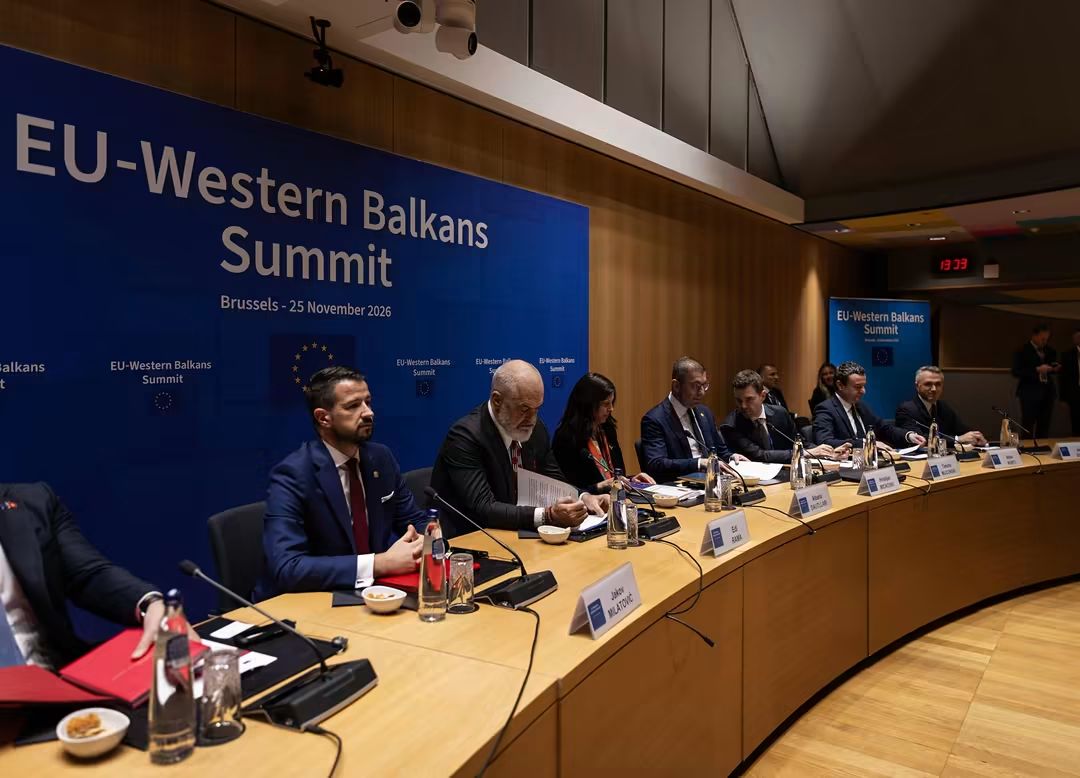
The European Union’s latest Enlargement Package sets out concrete accession roadmaps for four candidates, but new research reveals widening differences in reform preparedness. While Montenegro and Albania advance, North Macedonia remains blocked, Serbia faces a foreign policy dilemma, and Kosovo and Bosnia struggle with institutional paralysis.
BRUSSELS, Nov. 26, 2026 (BalkanView) — The European Union’s enlargement process is entering a new phase, with concrete accession timelines for its most advanced candidates and growing differences in institutional preparedness across the Western Balkans.
The European Commission’s latest Enlargement Package, presented on Wednesday, outlines roadmaps for Montenegro, Albania, Moldova and Ukraine, while highlighting persistent political and institutional obstacles facing other candidates.
Separate research published by Brussels-based economic think tank Bruegel shows that Montenegro and Albania have significantly improved their preparedness to implement EU legislation, while North Macedonia and Serbia have recorded more modest progress since 2020.
An analysis by Tinatin Akhvlediani of the Centre for European Policy Studies (CEPS) argues that the credibility of enlargement increasingly depends not only on candidate countries delivering reforms but also on EU member states fulfilling their commitments.
The two assessments highlight different dimensions of enlargement: technical preparedness, political conditionality and the willingness of existing member states to accept new members.
Montenegro could become the EU’s 28th member in 2028
Montenegro is approaching a decisive stage in accession negotiations that began in 2012.
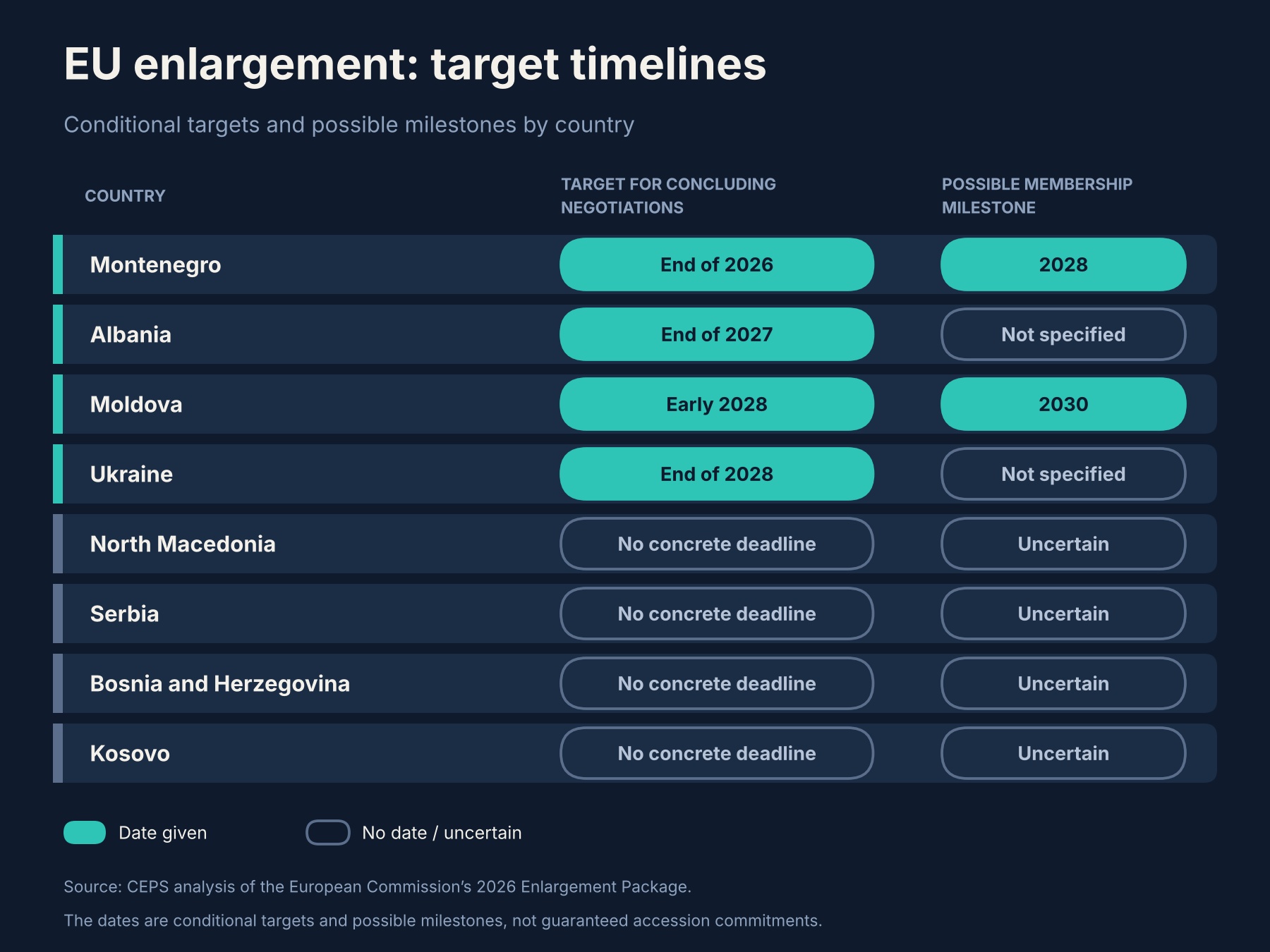
According to the CEPS analysis, the Commission’s roadmap envisages concluding negotiations by the end of 2026, potentially allowing an Accession Treaty to be signed as early as June 2027.
Membership could follow in 2028, provided outstanding obstacles are resolved and the necessary ratification procedures are completed.
European Council President António Costa confirmed on Wednesday that work on drafting Montenegro’s Accession Treaty had already begun, describing it as a step the EU had not taken in more than a decade.
Bruegel’s latest dataset also shows substantial improvements in Montenegro’s preparedness to implement European legislation.
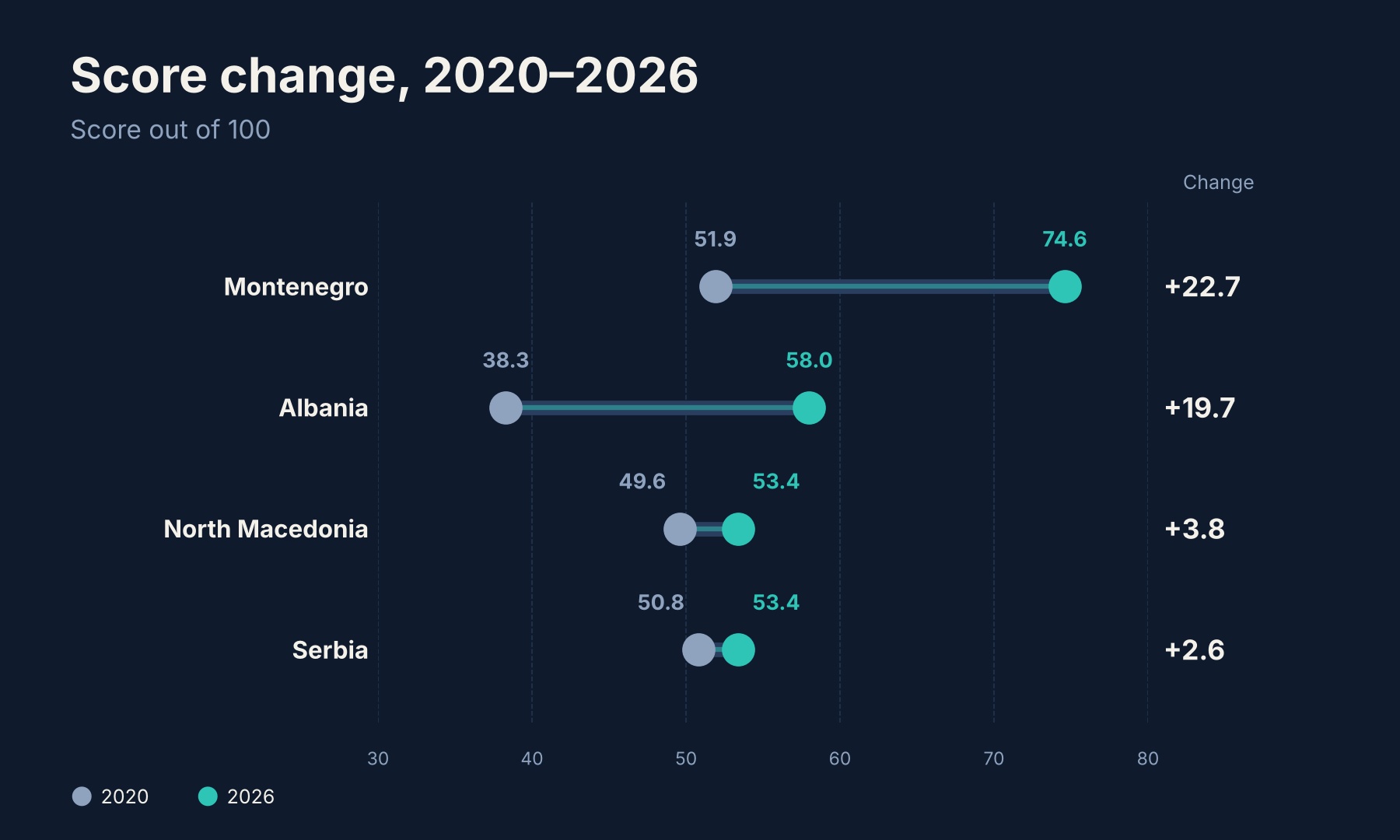
Its average preparedness score across 33 negotiating chapters increased from 51.9 points in 2020 to 74.6 in 2026.
Over the past year alone, its score increased by 13.3 points.
However, CEPS identifies Croatia’s outstanding bilateral demands as a significant obstacle that could affect Montenegro’s accession timetable.
The think tank argues that Montenegro’s accession will become an important test of whether the EU can translate its renewed enlargement commitments into membership.
Albania overtakes North Macedonia in reform preparedness
Albania has opened all six negotiating clusters in just over a year and is working towards concluding accession negotiations by the end of 2027.
Its progress is also reflected in Bruegel’s dataset.
Albania’s average preparedness score increased from 38.3 points in 2020 to 58.0 in 2026, representing an improvement of 19.7 points.
In 2020, Albania was more than 11 points behind North Macedonia. It has since moved approximately 4.6 points ahead.
Costa confirmed that Albania had started closing negotiating chapters, marking another milestone in its accession process.
Nevertheless, CEPS warns that the speed of formal negotiations should not overshadow concerns about democratic governance, fundamental rights and the rule of law.
Akhvlediani also points to ongoing public protests in Albania, arguing that the country’s accession process must produce meaningful institutional transformation rather than simply satisfy procedural requirements.
North Macedonia: Financial rewards, political obstacles and slow reforms
North Macedonia presents a particularly complex picture.
The country has accelerated the implementation of reforms under the EU Growth Plan and maintained full alignment with the bloc’s common foreign and security policy.
It is also expected to benefit from the European Commission’s planned redistribution of Growth Plan resources towards countries that have met more of their reform commitments.
Prime Minister Hristijan Mickoski said ahead of Wednesday’s EU–Western Balkans summit that Skopje expected an additional €75 million under the financial instrument.
However, progress under the Growth Plan has not translated into comparable improvements across the broader range of EU accession requirements.
According to Bruegel’s calculations, reported by Inbox7, North Macedonia’s average preparedness score increased from 49.6 points in 2020 to 53.4 in 2026 — an improvement of just 3.8 points over six years.
Between 2025 and 2026, the country improved its preparedness assessment in only two of the 33 chapters examined:
- Information society and media;
- Education and culture.
The remaining 31 chapters recorded no change in their coded preparedness assessments.
The judiciary and fundamental rights remain among the weaker areas, with a score of 37.5 points, while environmental protection and climate change received 25 points.
North Macedonia’s formal accession process also remains constrained by the requirement to adopt constitutional amendments.
According to CEPS, the current government faces domestic political difficulties over the amendments and concerns that Bulgaria could subsequently introduce further demands concerning language, history and the implementation of the 2017 Friendship Treaty.
The combination of political obstacles and limited improvements in technical preparedness complicates Skopje’s efforts to advance towards membership.
Six years of uneven reform progress
Bruegel’s dataset converts the European Commission’s qualitative assessments of candidate countries into numerical values on a scale from zero to 100.
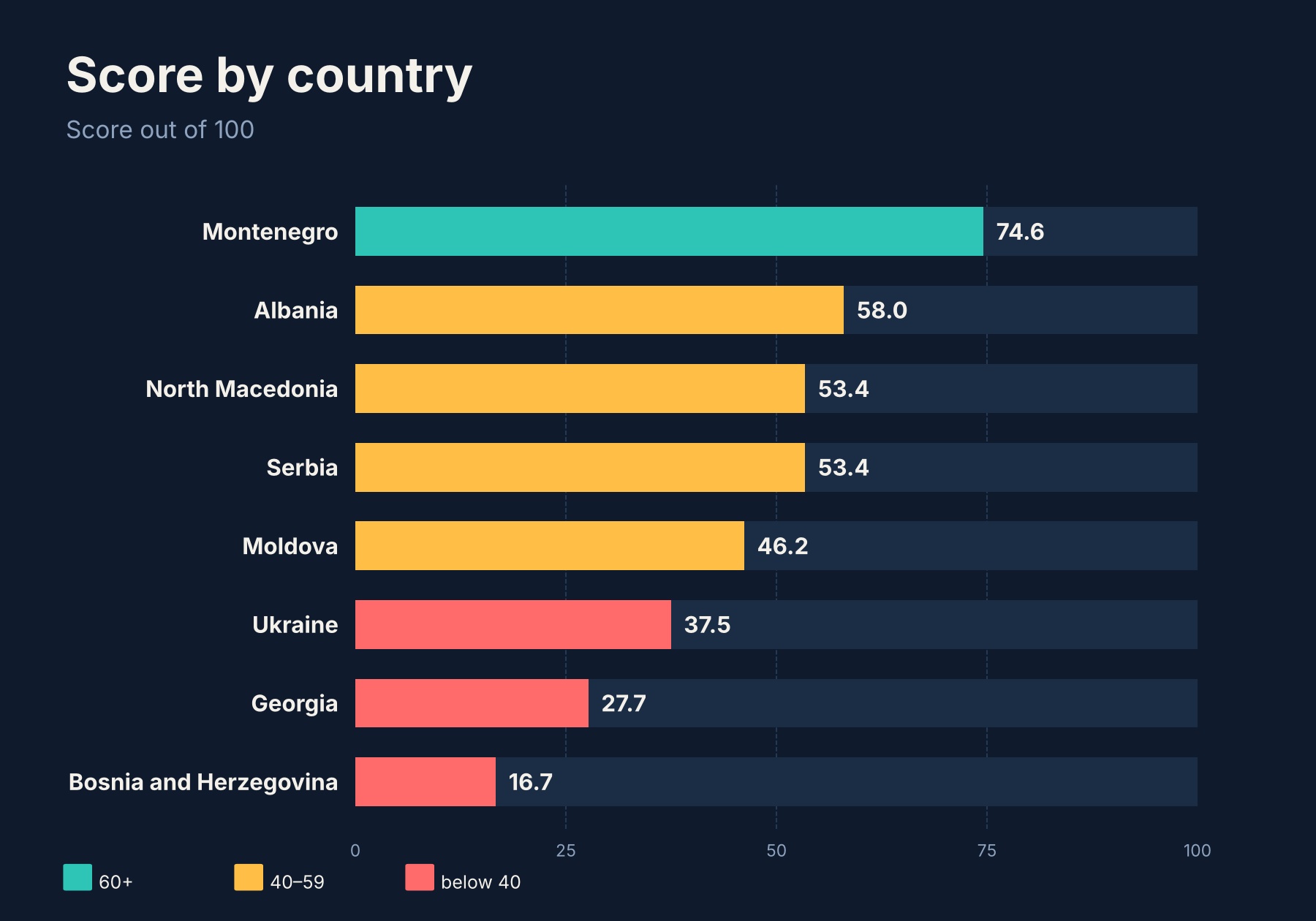
The figures measure preparedness across negotiating chapters rather than the percentage of membership requirements fulfilled. They are not an official European Commission ranking or a prediction of accession dates.
The data illustrate how countries that had relatively similar preparedness assessments six years ago have subsequently followed different reform trajectories.
Serbia’s political transition faces a European test
Serbia’s recent change of political leadership has opened a new chapter in its relationship with Brussels, following the end of Aleksandar Vučić’s ruling party’s 14-year period in power.
The Student List, which emerged from the country’s protest movement, now holds a parliamentary majority and is expected to form the next government.
Its representatives have expressed support for reforms addressing corruption, judicial independence, media freedom and the rule of law.
However, uncertainty remains over whether the incoming leadership will significantly change Serbia’s foreign policy.
Serbia did not attend Wednesday’s EU–Western Balkans summit in Brussels, with representatives of the new parliamentary majority citing domestic parliamentary obligations.
The absence postponed an opportunity for the EU to assess the new leadership’s position on foreign policy alignment, sanctions against Russia and relations with Kosovo, Euronews reported.
A Eurobarometer survey published in May found that 67% of Serbian respondents opposed sanctions against Russian government entities, individuals and companies.
Student List representatives have indicated that the issue should be addressed through public debate.
Brussels also expects Belgrade to continue the EU-facilitated dialogue with Pristina and implement commitments made under previous agreements.
Bruegel’s data show that Serbia’s average preparedness score increased from 50.8 in 2020 to 53.4 in 2026, the same level recorded by North Macedonia.
CEPS argues that the EU should engage with Serbia’s emerging leadership to help translate its domestic reform commitments into progress in accession negotiations.
Kosovo and Bosnia remain constrained by institutional crises
Kosovo continues to identify European integration as a strategic priority, but prolonged institutional difficulties have slowed the implementation of reforms.
Its accession prospects are further complicated by limited progress in normalising relations with Serbia and the refusal of five EU member states to recognise its independence.
These obstacles prevent a political consensus within the EU on formally advancing Kosovo’s accession process.
Bosnia and Herzegovina faces persistent institutional paralysis and disagreements among political leaders over reforms required by Brussels.
According to CEPS, the absence of sufficient political commitment to implement reforms continues to constrain the country’s European integration.
Both Kosovo and Bosnia and Herzegovina, alongside Serbia, have reportedly forfeited portions of their EU Growth Plan allocations after missing reform deadlines.
The European Commission plans to redistribute significant resources to countries that have made more progress under the instrument, although the exact amounts remain to be announced.
Moldova and Ukraine introduce a new eastern dimension
The Western Balkans are no longer the only focus of the EU’s enlargement agenda.
Moldova is working towards concluding accession negotiations by early 2028, with membership envisaged by 2030 under the roadmap described by CEPS.
The Commission considers the timetable achievable if the country maintains its reform momentum.
Ukraine is pursuing a target of concluding negotiations by the end of 2028, despite the substantially more difficult circumstances created by Russia’s war.
The Commission’s provisional roadmap envisages closing seven negotiating chapters for Ukraine in 2027, compared with 25 for Moldova.
Their different reform trajectories have raised questions about whether the two countries should continue advancing together through the accession process.
Meanwhile, Georgia’s accession process remains effectively halted amid concerns over democratic backsliding, while Turkey’s negotiations have been stalled since 2018.
The emerging accession calendar
Brussels must also prepare for enlargement
The European Commission has proposed changes to the EU’s internal decision-making procedures to prepare the bloc for additional members.
These include greater use of qualified majority voting for intermediate accession decisions, stronger safeguards in future accession treaties and transitional arrangements in sensitive policy areas such as agriculture.
Reducing the scope for individual member states to block intermediate steps could address some of the bilateral obstacles that have delayed previous enlargement processes.
However, CEPS notes that securing unanimous support from existing member states for such changes would be difficult.
The proposed framework also envisages stronger post-accession safeguards, potentially extending over a 15-year period, which the think tank warns could impose excessive restrictions on incoming members.
Gradual integration into EU institutions and policies is another component of the new approach.
Montenegro, for example, could receive observer status in the European Parliament and participate in relevant Commission activities before formally becoming a member.
The Commission frames gradual integration as a complement to full membership rather than an alternative to it.
From enlargement promises to accession treaties
Wednesday’s EU–Western Balkans summit reaffirmed the bloc’s commitment to regional enlargement.
“Enlargement is a realistic possibility, and it should be seized,” European Council President António Costa said following the meeting.
But the latest Enlargement Package and independent research point to an increasingly differentiated process, in which countries are advancing according to their own reform records and political circumstances.
Montenegro is preparing for a potential accession treaty. Albania is working towards completing negotiations. North Macedonia is pursuing reform-related financial incentives while its formal negotiations remain constrained. Serbia is undergoing a political transition, while Kosovo and Bosnia face unresolved institutional and political challenges.
For the European Union, Montenegro’s accession could become the first major test of its renewed enlargement strategy.
For the Western Balkans, the coming years will demonstrate whether the region’s increasingly divergent reform trajectories lead to a new wave of EU membership or prolong the accession process for countries still facing significant obstacles.