



Albania, Kosovo and North Macedonia lead the region’s growth forecasts for 2026, while Serbia is expected to accelerate in 2027. Persistent inflation, external deficits and structural weaknesses threaten to slow economic convergence with the European Union.
SKOPJE, Nov. 14, 2026 (BalkanView) – The six Western Balkan economies are expected to grow faster than the European Union in 2026, according to the International Monetary Fund, offering signs of economic resilience in a region seeking closer integration with the bloc despite persistent inflation, demographic pressures and structural weaknesses.
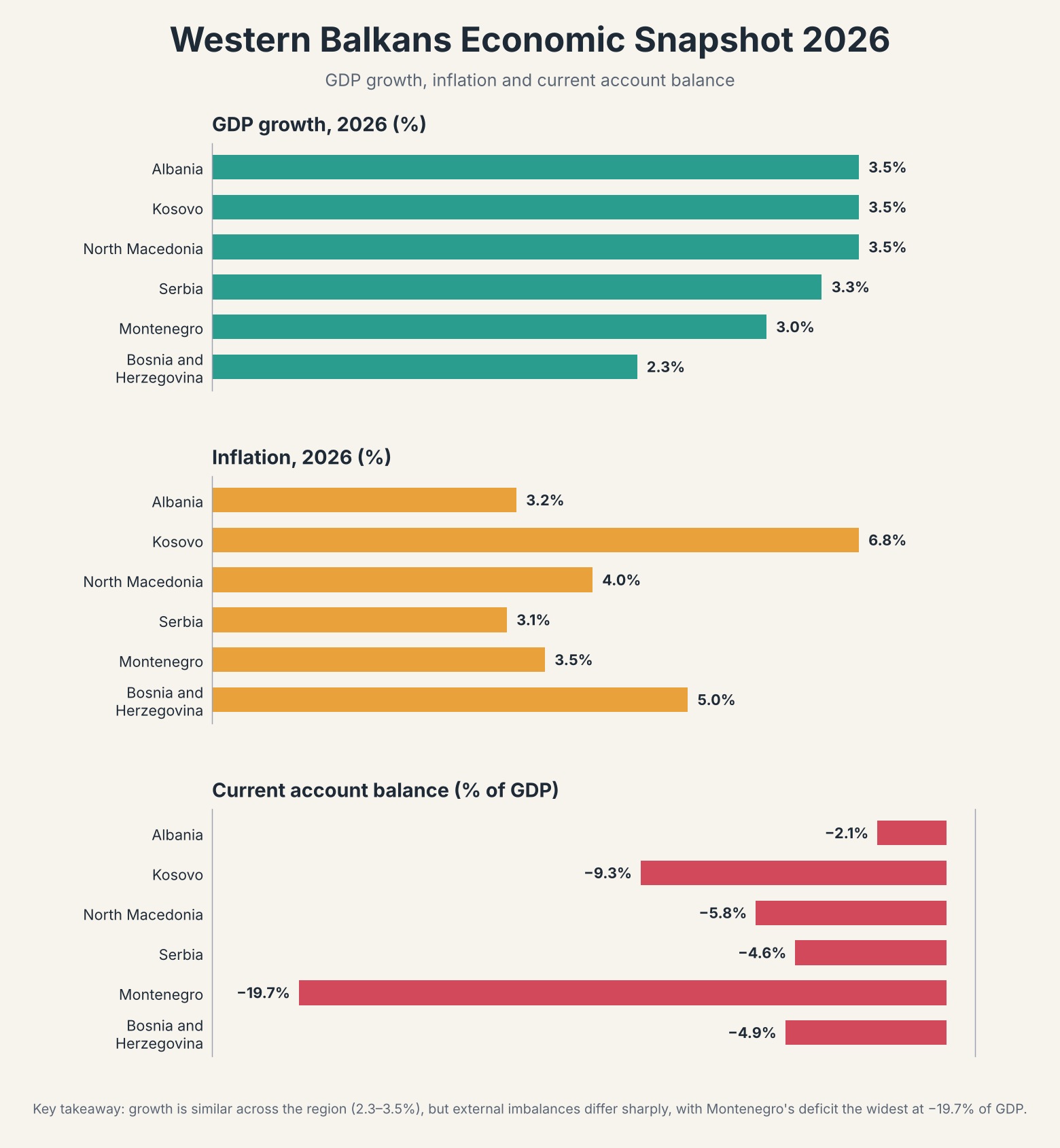
The IMF’s October World Economic Outlook projects economic growth of 3.5% in Albania, Kosovo and North Macedonia this year, placing them jointly at the top of the regional growth rankings.
Serbia is expected to expand by 3.3%, followed by Montenegro at 3.0% and Bosnia and Herzegovina at 2.3%.
All six economies are projected to outperform the EU, where growth is forecast at 1.4%, and the euro area, which is expected to expand by 1.1%.
The forecasts come against a backdrop of global economic uncertainty. The IMF expects the world economy to grow by 3.1% in 2026, with emerging and developing economies expanding by 3.7% and advanced economies by 2.1%.
While the Western Balkans’ relatively stronger growth could help narrow the economic gap with the EU, differences in inflation, external balances and labour market conditions suggest that the region’s recovery remains uneven.
Three economies lead the region
Albania, Kosovo and North Macedonia are each projected to record real GDP growth of 3.5% in 2026, exceeding the global forecast by 0.4 percentage points.
However, the three economies face different economic challenges.
Albania is expected to maintain relatively strong growth while recording annual inflation of 3.2% and a current account deficit equivalent to 2.1% of GDP.
Its economic expansion has benefited in recent years from tourism, construction and investment, although dependence on these sectors leaves the economy exposed to fluctuations in external demand.
North Macedonia is forecast to maintain its 2025 growth rate of 3.5%, with inflation projected at 4.0%.
The IMF expects its current account deficit to widen to 5.8% of GDP in 2026, from 4.4% in 2025.
For an economy closely linked to European manufacturing supply chains, weak growth among major trading partners remains a potential constraint on exports and investment.
Kosovo is also expected to grow by 3.5%, but faces the highest inflation rate among the six economies, at 6.8%.
Its current account deficit is projected at 9.3% of GDP, highlighting the importance of external financing and the economy’s dependence on imported goods.
The contrast illustrates why similar GDP growth rates do not necessarily translate into similar improvements in household purchasing power or economic stability.
Serbia expected to accelerate
Serbia, the largest economy in the Western Balkans, is projected to grow by 3.3% in 2026, up from 2.0% in 2025.
The IMF expects growth to accelerate further to 4.0% in 2027, making Serbia the region’s fastest-growing economy next year.
The forecast points to a potentially stronger recovery after a period of weaker economic expansion.
Serbia’s inflation is expected to average 3.1% in 2026, while its current account deficit is projected at 4.6% of GDP.
The country remains an important destination for foreign investment in the region, with manufacturing, infrastructure and services contributing to economic activity.
However, the outlook remains subject to domestic political developments, investor confidence and economic conditions in the European Union, Serbia’s largest trading partner.
The IMF forecasts indicate that Serbia’s growth could gain momentum even as expansion slows slightly in several neighbouring economies.
Montenegro’s external deficit stands out
Montenegro is expected to grow by 3.0% in 2026, compared with 2.7% in 2025, before slowing to 2.8% in 2027.
Its inflation rate is projected at 3.5%.
However, Montenegro stands out for the size of its current account deficit, forecast at 19.7% of GDP in 2026, the highest among the six Western Balkan economies.
The deficit reflects a substantial imbalance between the country’s external receipts and payments, making access to external financing particularly important.
Montenegro’s economy relies heavily on tourism and services, while domestic consumption and investment generate significant demand for imports.
The country is also among the frontrunners in EU accession negotiations, offering potential opportunities for further investment and economic integration.
But its external deficit illustrates the challenges facing small, open economies whose growth depends heavily on foreign demand and capital flows.
Bosnia and Herzegovina trails the region
Bosnia and Herzegovina is projected to record the weakest economic growth in the Western Balkans, at 2.3% in 2026.
The forecast represents a slight slowdown from 2.4% in 2025, with growth expected to recover to 2.6% in 2027.
Inflation is forecast at 5.0%, the second-highest rate in the region after Kosovo.
The combination of weaker growth and relatively high inflation could place additional pressure on household purchasing power.
Bosnia and Herzegovina also faces longstanding institutional and political challenges that can complicate economic policymaking, investment and the implementation of reforms.
Although its projected growth remains above the EU average, the gap with faster-growing Western Balkan economies could make regional economic convergence more difficult.
Inflation threatens to erode economic gains
The IMF’s forecasts suggest that inflation remains a significant challenge across the Western Balkans, even as economic growth continues.
Kosovo’s projected inflation rate of 6.8% is more than twice Serbia’s 3.1%.
Bosnia and Herzegovina faces inflation of 5.0%, while North Macedonia is expected to record 4.0%, Montenegro 3.5% and Albania 3.2%.
Higher consumer prices can reduce the purchasing power of wages and pensions, particularly in economies where households spend a substantial share of their income on food, energy and other essential goods.
The relationship between economic growth and living standards is therefore more complex than headline GDP figures suggest.
An economy can expand while some households experience declining purchasing power if their incomes fail to keep pace with rising prices.
For Western Balkan governments, maintaining price stability while supporting investment and employment remains a central economic challenge.
Faster than Europe, but still far behind
The region’s projected growth rates exceed those of the EU’s largest economies.
Germany is expected to grow by 1.3% in 2026, France by 0.4% and Italy by 0.8%, according to the IMF.
Among neighbouring EU members, Croatia is projected to expand by 2.2%, Bulgaria by 2.6% and Greece by 1.8%.
The comparison suggests that the Western Balkans have an opportunity to narrow the economic gap with the bloc.
But faster growth does not automatically mean rapid convergence.
Western Balkan economies start from substantially lower income levels than most EU member states, meaning that sustained growth over many years would be needed to close the gap.
Weak economic expansion in the EU can also affect the region through reduced demand for exports, slower investment and weaker economic conditions in countries hosting large Western Balkan diaspora communities.
The region’s dependence on European markets means that outperforming the EU does not insulate it from Europe’s economic difficulties.
Growth alone may not solve the demographic crisis
The economic forecasts come as the Western Balkans confront a longer-term challenge: shrinking and ageing populations.
Low fertility and migration threaten to reduce the region’s working-age population, potentially limiting the supply of labour and placing additional pressure on public finances.
At the same time, several Western Balkan economies continue to record relatively high unemployment, particularly among young people.
The coexistence of labour shortages and unemployment points to structural weaknesses, including skills mismatches, regional disparities and differences between employment opportunities at home and abroad.
For governments, the challenge is to translate economic expansion into productive employment, higher wages and improved public services.
Without such improvements, stronger GDP growth may not be sufficient to reduce incentives for migration.
The region’s demographic outlook also increases the importance of productivity gains, investment in education and technology, and policies that encourage greater labour force participation.
World Bank sees stronger regional growth
The World Bank’s latest Western Balkans Regular Economic Report, published in October 2026, offers a broadly similar assessment of the region’s economic outlook.
It projects combined Western Balkan growth of 3.1% in 2026, up from 2.6% in 2025, followed by growth of 3.4% in both 2027 and 2028.
The World Bank identifies consumption and investment as important drivers of the recovery.
However, it also highlights the need to reduce trade costs, improve business competitiveness and create better employment opportunities.
The report suggests that economic resilience alone will not be sufficient to accelerate convergence with EU income levels.
Greater regional integration, more efficient trade procedures and improvements in the business environment could help Western Balkan companies expand into international markets.
The EU’s Growth Plan for the Western Balkans is intended to support that process through reforms, investment and gradual integration into parts of the European single market.
The test of economic convergence
The IMF forecasts offer grounds for cautious optimism.
All six Western Balkan economies are expected to expand in 2026, and all are projected to grow faster than the European Union.
Albania, Kosovo and North Macedonia lead this year’s regional growth forecasts, while Serbia is expected to take the lead in 2027.
Yet inflation, external deficits, demographic decline and uneven labour market performance remain substantial challenges.
For a region seeking EU membership, the economic objective extends beyond achieving growth rates higher than those of Western Europe.
It involves sustaining that growth long enough to raise living standards, improve institutional capacity and create employment opportunities that reduce the incentive for people to leave.
The Western Balkans may be growing faster than the EU. The more difficult question is whether they are growing fast enough to catch up.
Sources: International Monetary Fund, World Economic Outlook, October 2026; World Bank, Western Balkans Regular Economic Report, Fall 2026. Figures for 2026 and 2027 are forecasts and remain subject to revision.