


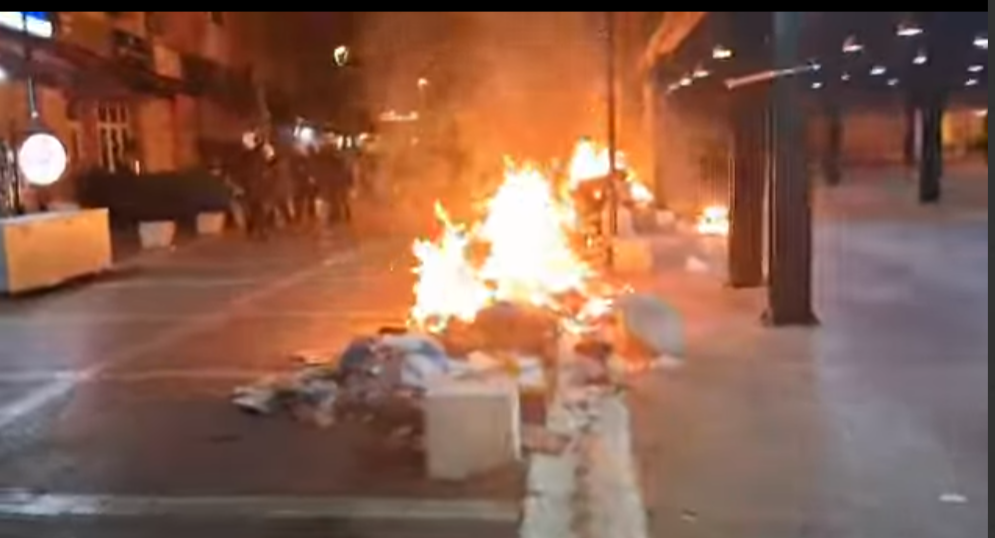
Albania’s political crisis deepened on Monday as protesters broke into a court building, hurled petrol bombs at government offices and clashed with police using tear gas, water cannon and rubber bullets.
TIRANA, Oct. 19 (BalkanView) — Albanian police clashed with anti-government protesters in central Tirana on Monday as demonstrations that began with student grievances entered their seventh consecutive day, spreading to judicial institutions and several cities outside the capital.
Protesters threw stones, fireworks and petrol bombs at police lines, while security forces responded with tear gas, water cannon and rubber bullets, according to Albanian broadcaster Top Channel.
The violence spread from the Education Ministry towards Skanderbeg Square, the Interior Ministry and Dibra Street, where demonstrators set rubbish containers on fire.
Special police unit RENEA was deployed near government headquarters for a third consecutive day, Albanian media reported.
Protesters break into appeals court
One of the most serious incidents occurred at Tirana’s Court of Appeal, where demonstrators breached security barriers, smashed windows and damaged the public entrance.
Some protesters entered the building, according to BalkanWeb and Top Channel. Media reports also described a fire at the court’s entrance.
Police arrested five suspects and were searching for another 15 people in connection with the incident, local media reported.
The attack followed a fire at the Supreme Court building two days earlier that damaged offices, furniture and judicial documents, raising concerns about the security of Albania’s courts.
Clashes also erupted outside the Interior Ministry, where protesters threw petrol bombs at the building. Police used tear gas to disperse the crowds.
A passer-by was injured near Barrikadave Street, although the severity of the injuries was not immediately clear.
BalkanWeb published footage that it said showed a police officer using pepper spray against News24 journalist Marcel Rupi while he was filming an arrest. The circumstances of the incident have not been independently established.
Violence spreads beyond Tirana
Demonstrations continued in Shkodra, Lezha, Elbasan and Korça, where students and other protesters called for Prime Minister Edi Rama’s resignation.
In Mirdita, protesters blocked a road near Rubik and burned tyres. In Kurbin, demonstrators threw petrol bombs at a municipal building, starting a fire near its entrance.
The protests, which began on October 13 over student grievances, have evolved into a broader anti-government movement driven by frustration over corruption, economic conditions and governance.
However, protesters remain divided over political leadership, with some distancing themselves from both the government and the opposition.
Rama offers talks but threatens tougher action
Rama reiterated his willingness to hold unconditional talks with students but said his government would not negotiate under pressure from violence.
He promised action against those responsible for attacks on police, public institutions and private property.
According to Albanian media, the government is considering additional restrictions and financial penalties for people identified as participants in violent incidents.
Reports also referred to proposals for travel restrictions affecting entry into European Union countries, although Albania cannot unilaterally impose such bans across EU member states.
Rama announced an additional payment of 2,500 euros for police officers deployed during the unrest, Top Channel reported.
The prime minister accused political opponents of encouraging violence and raised the possibility of foreign interference, including from Russia and Iran. No independently verified evidence supporting those allegations was presented in the reports.
Dozens arrested as political divisions deepen
Police said 69 people were arrested following Sunday’s disturbances, while proceedings were initiated against another 20.
Opposition leader Sali Berisha accused the government of excessive police force, while Rama maintained that violent groups were exploiting legitimate student grievances.
Some young demonstrators have rejected both political camps. In Shkodra, protesters called for both Rama and Berisha to face judicial accountability.
After seven days of unrest, the government and student representatives have yet to reach an agreement, leaving Albania facing a deepening political confrontation.