


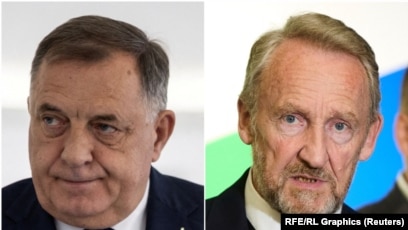
Milorad Dodik’s son emerges as a potential prime minister, Bakir Izetbegović loses his presidential bid despite his party’s electoral victory, and nationalist leaders prepare to dominate Bosnia’s next government. Analysts warn that political patronage, ethnic divisions and mass emigration are pushing the country towards a deeper crisis.
SARAJEVO, Oct. 18 (BalkanView) — Bosnia and Herzegovina’s October 4 general election has reinforced the dominance of ethnically based political parties, but delivered contrasting fortunes for two of the country’s most prominent political families, according to analysts interviewed by Radio Free Europe/Radio Liberty (RFE/RL).
While Milorad Dodik’s son Igor emerged as the leading vote-getter in the election for the Republika Srpska National Assembly, Bakir Izetbegović failed to secure a seat in Bosnia’s tripartite presidency despite a strong performance by his Party of Democratic Action (SDA).
The results have renewed debate about political dynasties, the influence of nationalist parties and whether Bosnia’s fragmented political system can produce meaningful reforms.
Enver Kazaz, a professor at the University of Sarajevo, and Srđan Puhalo, a social psychologist from Banja Luka, told RFE/RL that nationalism, political patronage and weak institutions continued to shape voting behaviour.
Dodik’s son emerges as potential prime minister
Igor Dodik, son of longtime Bosnian Serb leader Milorad Dodik, received the highest number of votes in the election for the Republika Srpska National Assembly, outperforming opposition politician Draško Stanivuković.
His father, who leads the Alliance of Independent Social Democrats (SNSD), has publicly indicated that he would not oppose Igor becoming prime minister of the Serb-majority entity.
However, Puhalo questioned whether the younger Dodik possessed the experience and political skills required to lead the government.
He argued that Igor’s electoral success reflected his father’s personal influence rather than public support for a political dynasty.
Puhalo described Milorad Dodik as both the greatest strength and the biggest vulnerability of SNSD, suggesting that the party’s future remained heavily dependent on its longtime leader.
Even if Igor becomes prime minister, Puhalo said, his father would retain decisive political influence.
The prospect of another Dodik family member assuming a senior government position has raised questions about the concentration of power in Republika Srpska.
Izetbegović suffers personal defeat despite SDA victory
In the Bosniak-majority political arena, the election produced a different outcome.
Although SDA emerged as the strongest party in the Federation of Bosnia and Herzegovina, its leader Bakir Izetbegović failed to win a seat in the state presidency.
Kazaz attributed the result to dissatisfaction with Izetbegović’s leadership and the declining appeal of his family’s political legacy.
Bakir Izetbegović is the son of Alija Izetbegović, Bosnia’s wartime president and one of the country’s most influential post-Yugoslav political figures.
According to figures cited by Kazaz, Bakir Izetbegović received approximately 190,000 votes.
His wife, Sebija Izetbegović, won about 5,800 votes in the election for the Federation parliament, compared with roughly 14,700 votes in the 2022 Sarajevo Canton Assembly election.
Kazaz interpreted the results as evidence of weakening personal support for the Izetbegović family, despite SDA’s continued electoral strength.
He also pointed to the growing popularity of Haris Zahiragić, an SDA politician who received approximately 39,000 votes in the state parliamentary election.
Kazaz argued that the party’s electoral base had shifted towards more uncompromising nationalist positions.
These assessments reflect the professor’s political analysis rather than an established consensus about the motivations of SDA voters.
Dodik and Čović could hold the balance of power
Both analysts expect Milorad Dodik and Croatian Democratic Union (HDZ) leader Dragan Čović to play central roles in negotiations over Bosnia’s next state-level government.
Their parties’ expected influence in the House of Peoples, a parliamentary chamber with significant powers over legislation, could give them considerable leverage over future coalition partners.
Puhalo said the two leaders were likely to seek Bosniak parties willing to cooperate with them.
He warned that any Bosniak party entering such a coalition could face political costs if it failed to deliver promised reforms.
Kazaz predicted that Čović would prioritise changes to Bosnia’s electoral legislation, an issue that has long divided Bosniak and Croat political representatives.
The proposed changes concern political representation and the method of electing officials in Bosnia’s complex power-sharing system.
The analysts said the balance of power could make it difficult to form a government without compromises among the country’s principal ethnic parties.
EU integration faces another political test
Bosnia’s European integration process could become a bargaining issue in coalition negotiations.
Puhalo questioned whether HDZ’s stated commitment to European integration would translate into support for substantial reforms.
He suggested that the prospect of European funding might encourage political leaders to adopt a more cooperative approach, even if their underlying positions remained unchanged.
Kazaz was more sceptical, arguing that Dodik would be unlikely to abandon his political strategy solely in exchange for EU financial assistance.
The analysts’ contrasting assessments highlight uncertainty over whether the next governing coalition will prioritise institutional reforms or continue the political disputes that have repeatedly slowed decision-making.
Nationalism, patronage and the politics of fear
Kazaz identified three factors behind the continued success of nationalist parties: ethnic fear, clientelist networks and religious influence.
He argued that political parties had built systems of dependence through public-sector employment, state institutions and affiliated networks.
Puhalo offered a similar explanation, saying Bosnia’s constitutional and political structure encouraged voters to support parties claiming to defend their respective ethnic communities.
He also blamed the poor performance of civic and liberal parties on their participation in governing coalitions that failed to deliver significant reforms.
According to Puhalo, the election marked a shift towards more conservative and nationalist political forces, particularly among Bosniak voters.
A country losing its young people
Beyond coalition politics, both analysts warned that demographic decline could pose a more serious long-term threat to Bosnia than the immediate election results.
Puhalo said continued emigration and an ageing population were transforming the country’s economic and social prospects.
He also expressed concern that Bosnia could become increasingly dependent on environmentally damaging industries and foreign investment projects with uncertain long-term benefits.
Kazaz warned that the departure of working-age citizens was weakening public services, universities and the pension system.
He cited declining university enrolment as an example, saying a department that previously admitted around 60 students had enrolled just two this year.
He also highlighted Bosnia’s dependence on money sent home by citizens living abroad.
The professor expressed concern that the country’s pension system could face growing pressure as the number of pensioners approaches the number of employed contributors.
His longer-term predictions were particularly pessimistic, although the interview did not establish that the institutional or economic collapse he fears is inevitable.
For both analysts, the election results revealed a political system focused on ethnic competition while the country’s demographic and economic problems continued to deepen.