


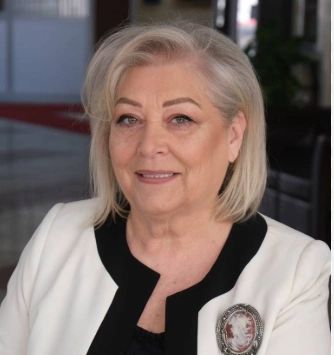
Kosovo’s long-running political crisis moved towards a dramatic resolution after Prime Minister Albin Kurti proposed 73-year-old economist and academic Justina Shiroka-Pula for president in a last-minute compromise with the opposition PDK, linking the presidential vote to controversial changes to the law governing the country’s Hague-based war crimes court.
PRISTINA, Oct 7 (BalkanView) — Kosovo’s ruling and opposition parties struck a last-minute political compromise around academic Justina Shiroka-Pula as they raced against a constitutional deadline that threatened to send the country into another parliamentary election.
Prime Minister Albin Kurti proposed Shiroka-Pula, the head of the Kosovo Academy of Sciences and Arts and a former minister and lawmaker for the Democratic Party of Kosovo, or PDK, after several earlier attempts to find an acceptable presidential candidate failed.
PDK leader Bedri Hamza said his party accepted Shiroka-Pula as a candidate, while announcing that PDK lawmaker Eliza Hoxha would also be nominated in the presidential process.
The breakthrough was tied to another politically sensitive issue: proposed amendments to the law governing the Kosovo Specialist Chambers, the Hague-based court dealing with crimes linked to the 1998-99 Kosovo war.
Under the compromise proposed by Kurti, parliament would first vote on the Specialist Chambers legislation and then proceed to the presidential election.
The arrangement brought together two issues that had paralysed negotiations for days and pushed Kosovo towards another institutional crisis.
The constitutional deadline for electing a president expired on Oct. 6. Failure to complete the process risked the dissolution of parliament and another early parliamentary election.
Why Shiroka-Pula became the compromise
Shiroka-Pula offered an unusual political bridge.
She has spent much of her professional life in academia but also has direct experience in the PDK, the main opposition force whose parliamentary participation was crucial to the presidential process.
Born in Pristina in 1953, Shiroka-Pula graduated from the University of Pristina’s Faculty of Economics in 1976 and completed postgraduate studies in economic development at the University of Zagreb.
She later earned a doctorate in economics in Pristina and built a decades-long academic career focusing on economics, management, development and operational research.
After briefly working at the People’s Bank of Kosovo, she joined the University of Pristina’s Faculty of Economics in the late 1970s and became a full professor in 2004.
Her academic career also extended beyond Kosovo.
From 1994 to 1999, she taught at the University of Tetovo, an institution that played an important role in the development of Albanian-language higher education in what is now North Macedonia. She was also engaged at the South East European University in Tetovo in 2003-2004.
She undertook additional academic work at institutions including Austria’s University of Linz and the University of Arizona in the United States.
From academia to government — and back again
Shiroka-Pula entered frontline politics with the PDK and served as Kosovo’s minister of energy and mining from 2008 to 2011 in the government of then-Prime Minister Hashim Thaci.
She subsequently represented the PDK in parliament from 2011 to 2014.
Her political background became particularly important during the presidential negotiations.
Kurti had faced PDK objections to candidates the opposition considered too closely associated with his Vetëvendosje movement. By proposing a former PDK minister who had spent years outside active party politics, he offered Hamza a candidate with connections to the opposition but whose more recent public profile was predominantly academic.
Shiroka-Pula returned to institutional academic life after leaving frontline politics.
She became a corresponding member of the Kosovo Academy of Sciences and Arts in 2016 and later assumed senior positions within the institution.
In December 2025, she was elected president of the Academy, becoming the first woman to lead Kosovo’s highest scientific and artistic institution since its establishment in 1975.
She succeeded academic Mehmet Kraja.
Her elevation to the Academy presidency strengthened a public profile increasingly centred on scholarship rather than party politics — a combination that eventually made her a possible bridge between Kurti’s Vetëvendosje and her former party.
The Hague court at the heart of the bargain
The presidential compromise cannot be understood without Kosovo’s increasingly contentious relationship with the Specialist Chambers.
The Hague-based institution operates under Kosovo law but is staffed by international judges and prosecutors. It was established in 2015 after international pressure for investigations into serious crimes allegedly committed by members of the Kosovo Liberation Army during and immediately after the 1998-99 conflict.
The issue returned to the centre of Kosovo politics following the September convictions of former KLA leaders, including former president Hashim Thaci.
The proposed amendments backed by the PDK seek substantial changes to the framework governing the court.
Among the proposals are a maximum prison sentence of 15 years, the possibility for sentences to be served in Kosovo and restrictions intended to bring the court’s jurisdiction closer to the allegations contained in the report by former Council of Europe rapporteur Dick Marty.
The initiative also proposes changes concerning appeals and international monitoring of the court.
The bill won overwhelming support at its first parliamentary reading on Oct. 5, with all 91 lawmakers taking part voting in favour.
But the first reading did not make the legislation law.
The measure still had to pass further parliamentary procedures and a second reading, and that final stage became the PDK’s central condition in negotiations over the presidency.
A court that divides Kosovo
The Specialist Chambers have become one of the most emotionally charged political issues in Kosovo.
Supporters of the institution say accountability for alleged war crimes must apply regardless of the status or wartime role of those accused.
Critics in Kosovo argue that the court disproportionately focuses on former KLA members and has moved beyond what they consider its original purpose.
The issue has become even more politically sensitive since the convictions of senior former KLA figures.
Shiroka-Pula herself recently expressed reservations about the Specialist Chambers, arguing publicly that justice must be perceived as equal and impartial.
Any attempt to change the court’s legal framework is likely to attract close international scrutiny because its operation rests not only on Kosovo legislation but also on constitutional provisions and international commitments made when the institution was established.
A race against midnight
The political negotiations unfolded under exceptional time pressure.
Kosovo’s Constitutional Court had set Oct. 6 as the end of the 60-day period for electing a president.
PDK insisted that parliament complete the Specialist Chambers legislation before its lawmakers participated in the presidential process.
Kurti eventually offered precisely that sequence.
His proposal was straightforward: Vetëvendosje lawmakers would support the Specialist Chambers legislation first, provided PDK lawmakers committed to participating in the presidential vote. Parliament would then move to Shiroka-Pula’s candidacy.
Hamza accepted her as an acceptable candidate.
The arrangement transformed Shiroka-Pula from an academic figure largely outside day-to-day party politics into the central figure in an agreement designed to prevent another institutional breakdown.
Why Kosovo’s presidency matters
Kosovo has a parliamentary system in which the president is head of state rather than head of government, but the office carries significant constitutional and symbolic authority.
The president represents the country internationally, plays a role in foreign policy and security institutions and is expected to embody political unity.
Electing one requires a degree of parliamentary cooperation that Kosovo’s fragmented political landscape has repeatedly struggled to produce.
A presidential candidate must initially secure the backing of at least 30 lawmakers.
The first two rounds require a two-thirds majority of parliament. If neither candidate reaches the threshold, a third round is held between the two leading candidates, when a lower threshold applies.
Failure to elect a president after the final round triggers the dissolution of parliament and an election within 45 days.
That mechanism turned the final hours of Oct. 6 into a political countdown.
From PDK minister to compromise figure
Shiroka-Pula’s trajectory helps explain why her name emerged when other candidates failed to bridge the divide.
She combines three identities rarely found in a single Kosovo presidential candidate: a senior academic, a former government minister and a former opposition-party lawmaker.
Her PDK past made her politically familiar to Hamza’s party.
Her long absence from frontline party politics allowed Kurti to present her as something broader than a conventional party candidate.
And her position as the first woman to lead the Kosovo Academy gave her an institutional profile independent of both parties.
What began as a dispute over who should occupy Kosovo’s presidency therefore ended with a political formula linking the country’s highest state office to one of its most contentious post-war legal institutions.
Shiroka-Pula, who only months earlier became the first woman to lead Kosovo’s Academy of Sciences and Arts, suddenly found herself at the centre of that compromise.
For Kosovo, however, the significance goes beyond one candidate.
The final hours of the presidential deadline demonstrated how two seemingly separate questions — the future of the Hague-based war crimes court and the choice of a head of state — became bargaining chips in the same effort to prevent the country from returning once again to the ballot box.