


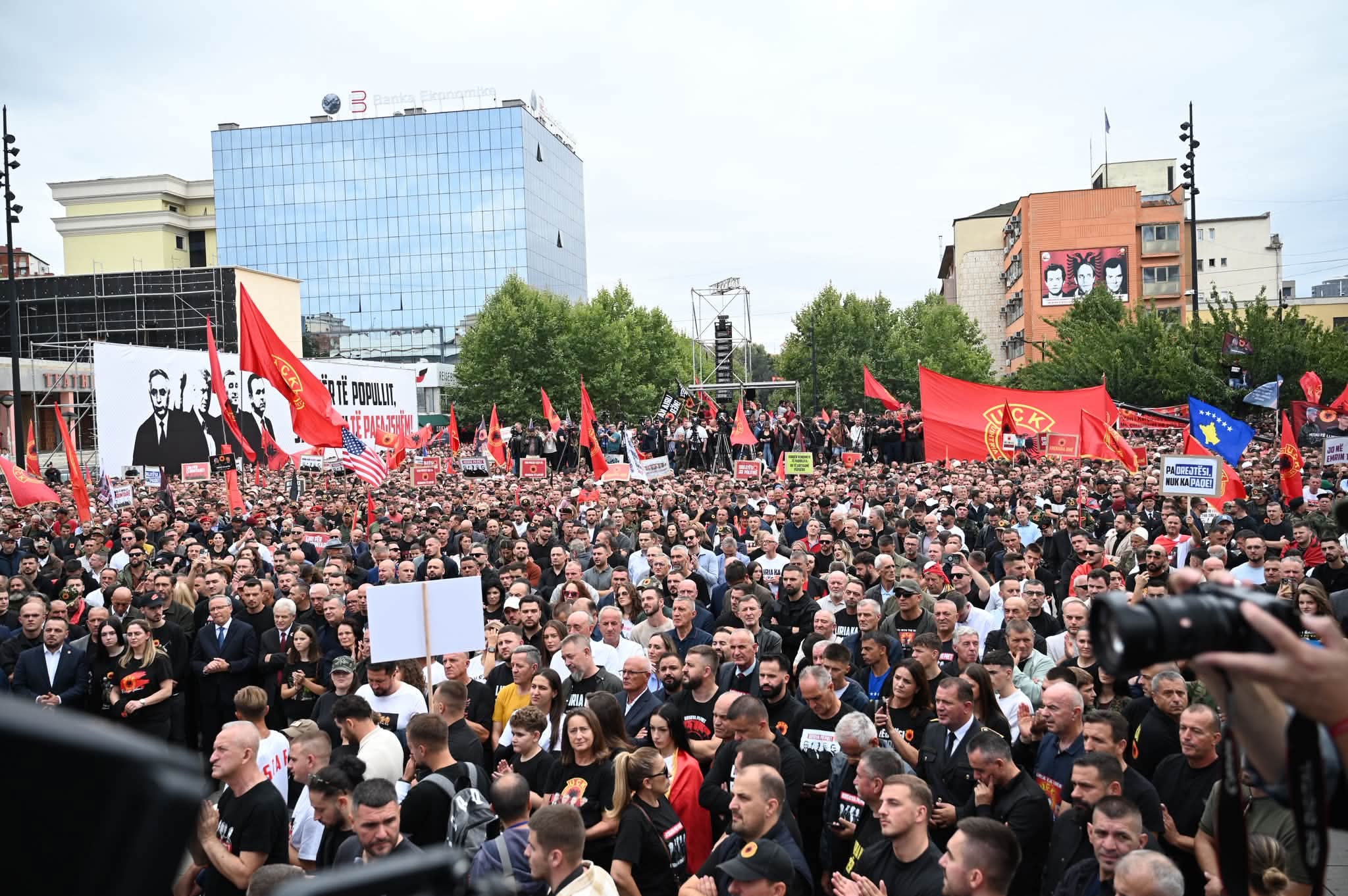
Thousands have rallied in Pristina ahead of the Sept. 16 judgment against Hashim Thaçi and three other former KLA leaders. Formally, four men are on trial. Politically, however, the ruling could shape how the Kosovo war is remembered, deepen tensions with Serbia and test whether international justice can ever produce reconciliation in the Balkans.
PRISTINA/THE HAGUE, Sept 13 (BalkanView) – Kosovo is entering one of its most politically sensitive weeks since independence as a Hague-based court prepares to deliver its trial judgment against former president Hashim Thaçi and three other former leaders of the Kosovo Liberation Army, or KLA.
The Kosovo Specialist Chambers is due to deliver the judgment on Sept. 16 against Thaçi, Kadri Veseli, Rexhep Selimi and Jakup Krasniqi. The four have pleaded not guilty to all charges.
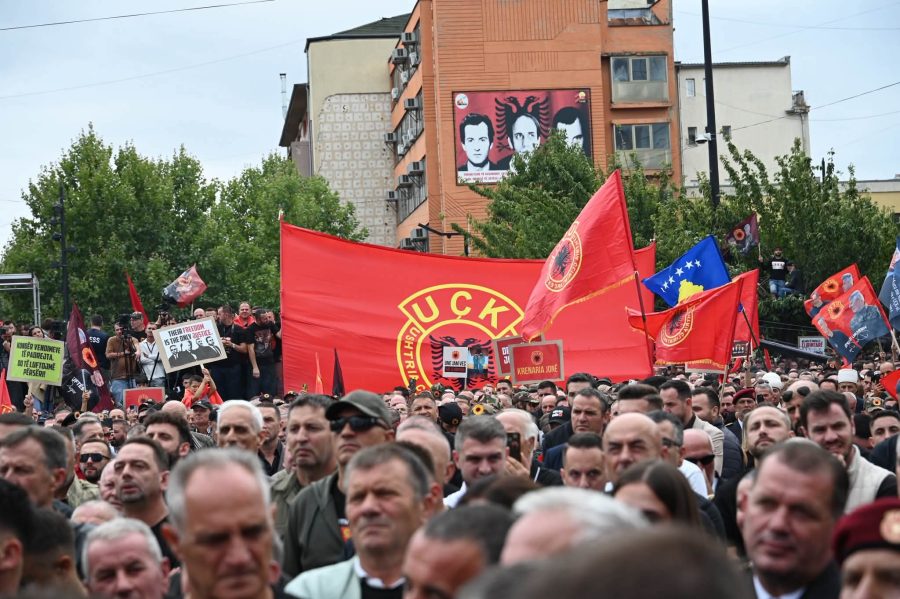
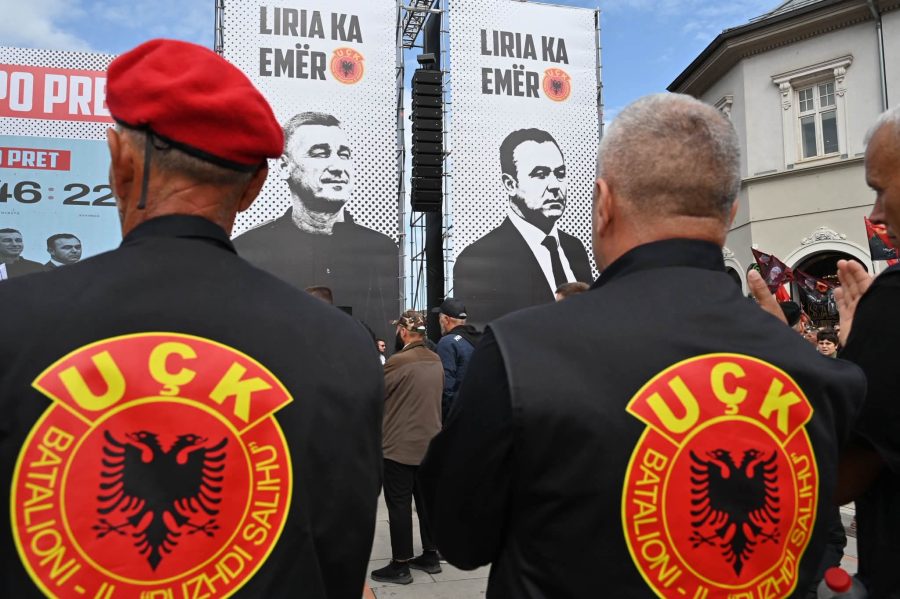
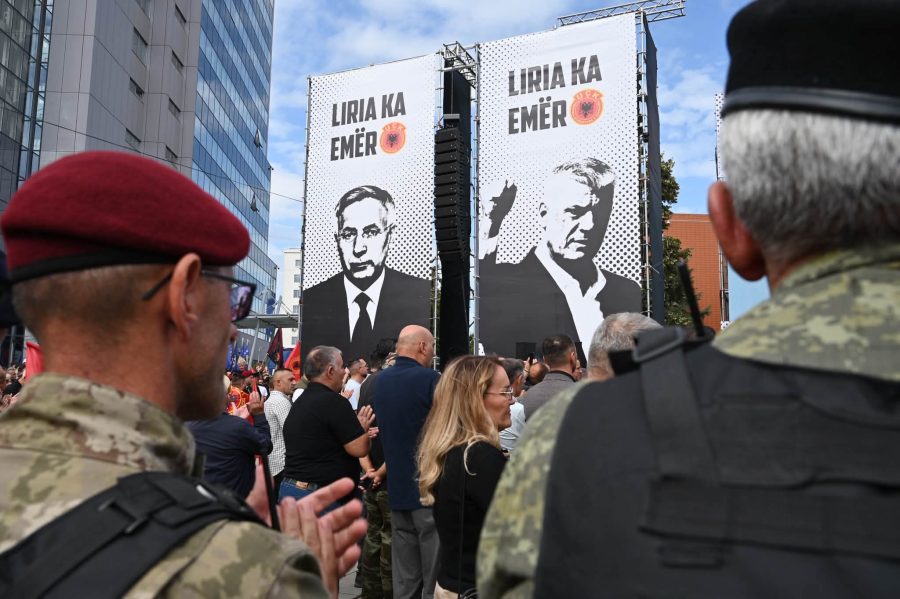
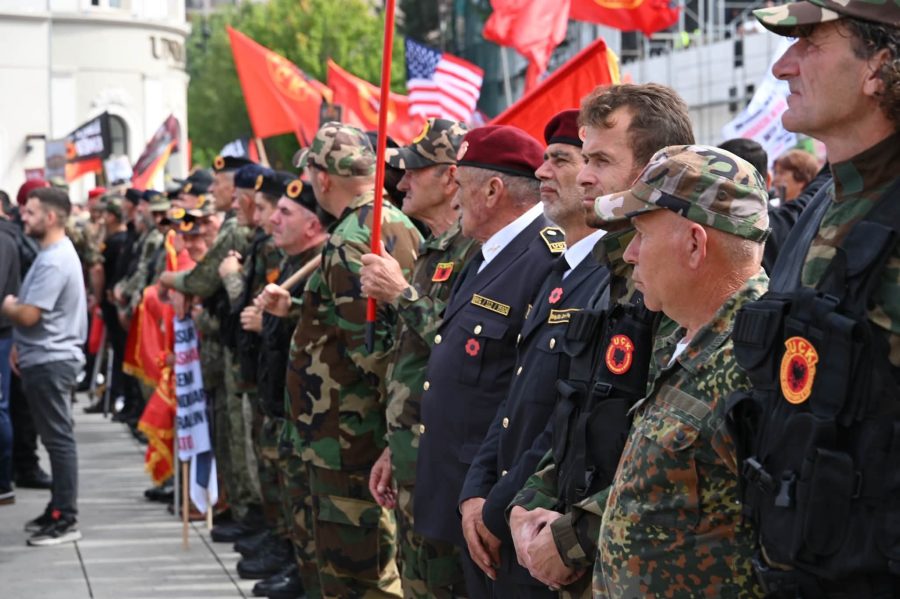
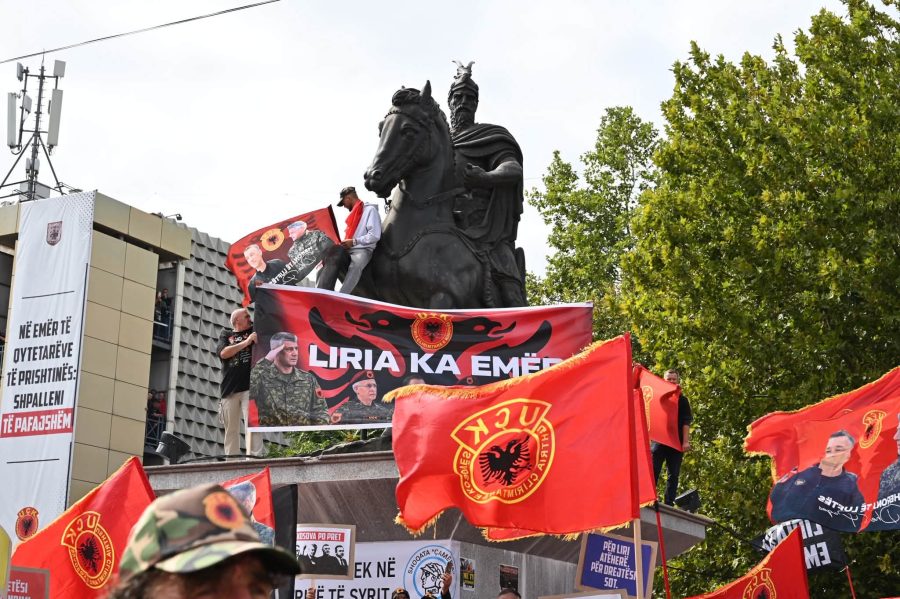
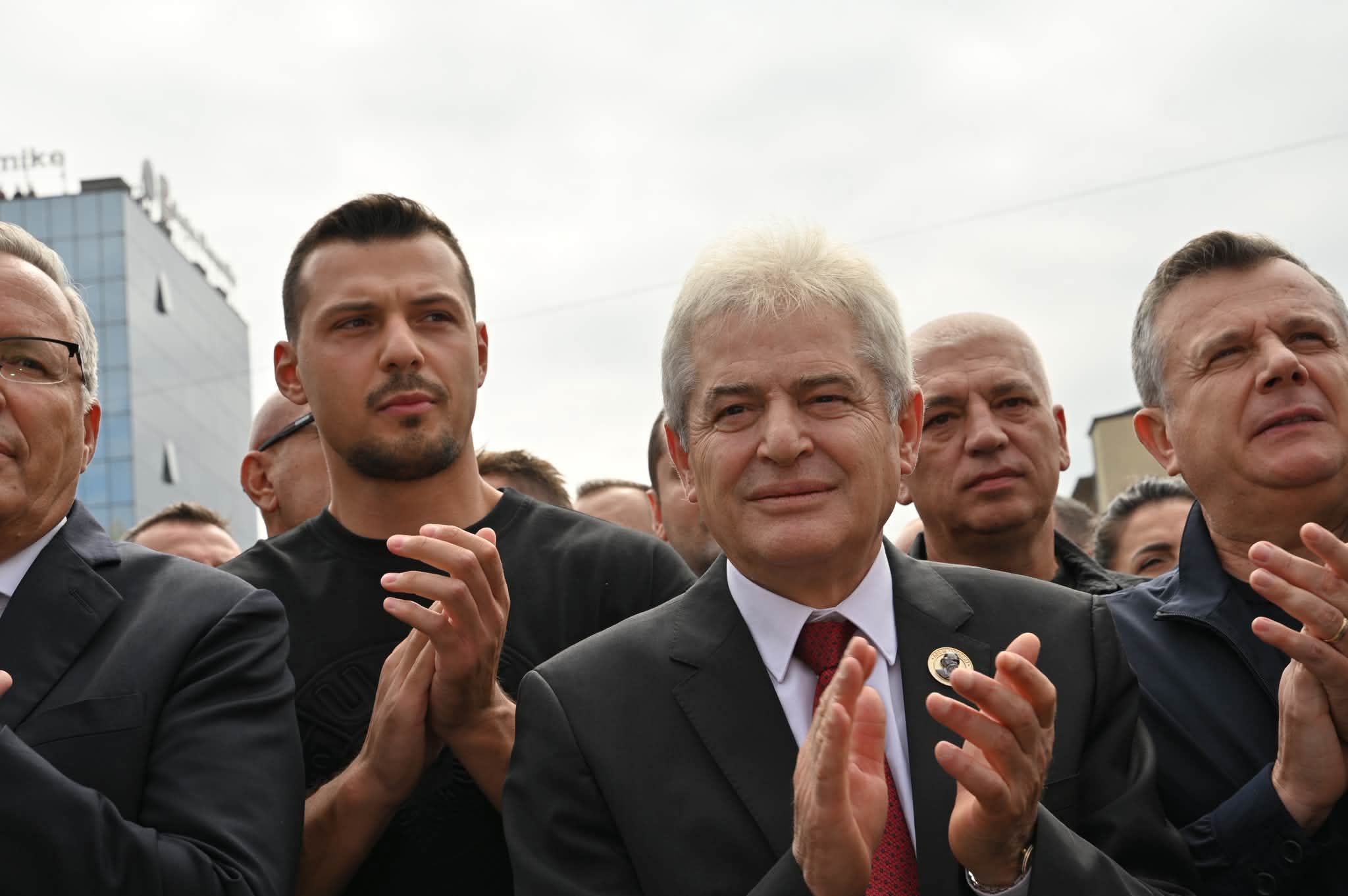
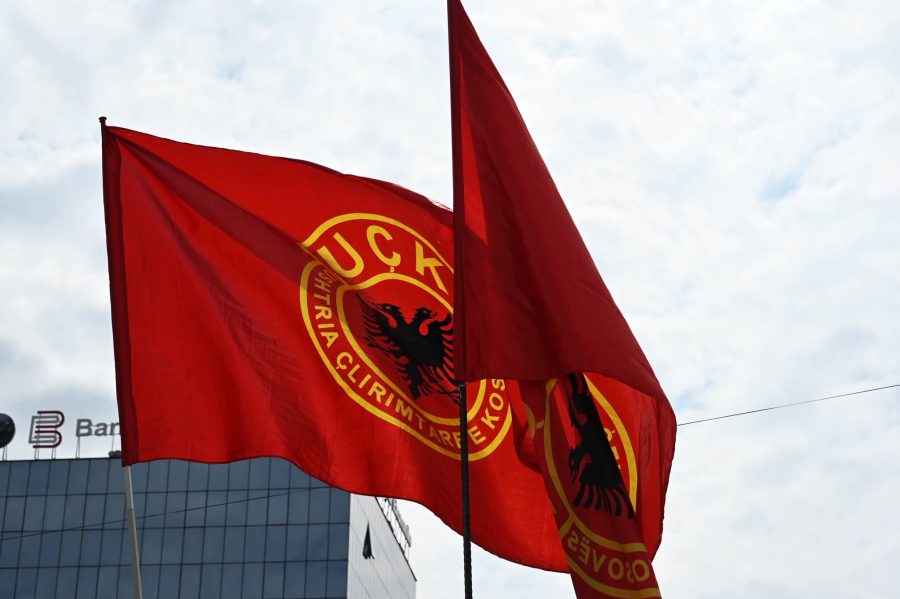
Three days before the ruling, central Pristina filled with Kosovo, Albanian and KLA flags as thousands joined a “March for Freedom” in support of the defendants.
Political leaders, veterans and relatives of wartime fighters addressed the crowd, arguing that the proceedings should judge individuals without rewriting the history of Kosovo’s struggle against Serbian rule.
Veterans’ leader Hysni Gucati said the movement wanted a fair and impartial process and warned that an unjust outcome would benefit Serbia and Russia.
“Freedom in Kosovo was won through sacrifice. No courtroom can erase that truth,” he said.
Democratic Party of Kosovo leader Bedri Hamza said a decision perceived as unjust would not be accepted quietly and told those delivering the verdict to “think about the consequences”.
The rally underlined a tension that has followed the Specialist Chambers since its creation: legally, the case concerns the criminal responsibility of four men; politically, many Kosovars see the proceedings as a judgment on the KLA itself.
A case years in the making
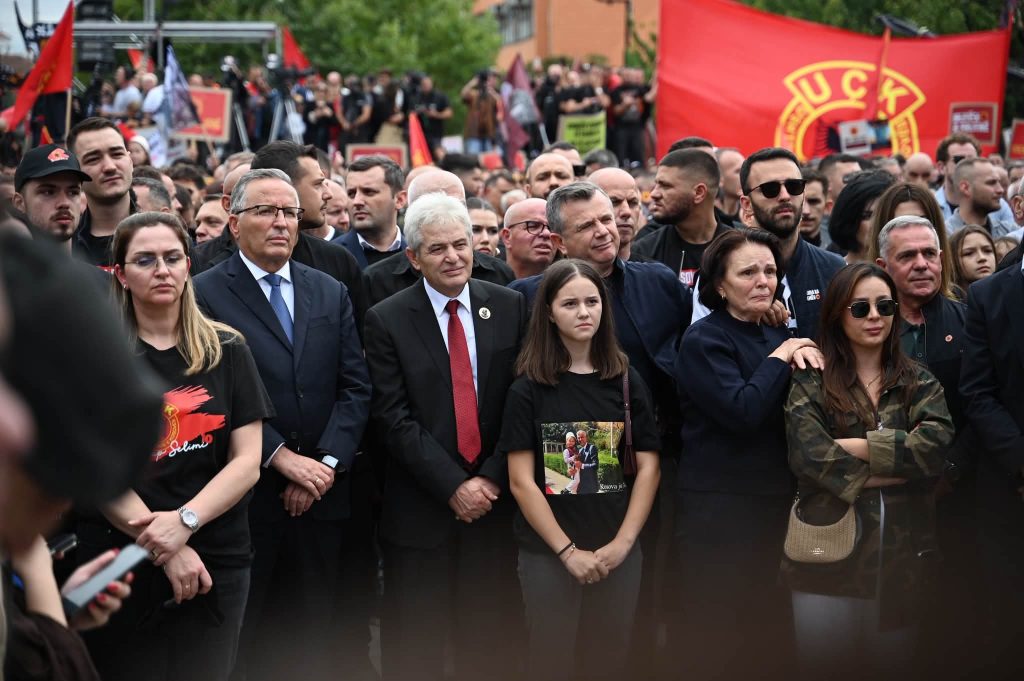
Thaçi, Veseli, Selimi and Krasniqi have been in detention in The Hague since November 2020.
Their trial began on April 3, 2023.
The prosecution closed its case in April 2025, while the defence concluded its presentation later that year. Closing arguments were held in February 2026.
The indictment includes six counts of crimes against humanity and four counts of war crimes. Prosecutors allege that crimes including persecution, imprisonment, torture, murder and enforced disappearance were committed between at least March 1998 and September 1999 in Kosovo and at locations in northern Albania.
The prosecution has sought sentences of 45 years for each defendant.
The defence has asked for acquittal.
Not a verdict on the KLA – legally
The Specialist Chambers is not trying the KLA as an organisation.
It is deciding whether four named defendants bear individual criminal responsibility for specific crimes alleged by prosecutors.
That distinction will be central after the judgment.
A conviction would not legally establish that the KLA as a whole was a criminal organisation.
An acquittal would not mean that no crimes were committed during or after the conflict.
But the political debate is unlikely to respect that legal boundary.
In Kosovo, an adverse judgment could be portrayed as an attack on the legitimacy of the liberation struggle.
In Serbia, convictions could be used to reinforce claims that the KLA was fundamentally criminal.
The same judgment could therefore produce two completely different national narratives.
Waters: The legal theory could reach far beyond four defendants
Timothy Waters, a professor of law at Indiana University and specialist in international criminal law who worked on the Slobodan Milošević case before the International Criminal Tribunal for the former Yugoslavia, says the implications of the case could extend well beyond the four defendants.
Waters said the prosecution’s reliance on the doctrine of joint criminal enterprise, or JCE, is central to understanding the case.
Under that theory, prosecutors can seek to establish responsibility for defendants who are not alleged to have personally committed every murder, detention or act of torture, but who are said to have participated in or contributed to a broader common criminal purpose.
That makes the key question not merely whether crimes occurred, but whether prosecutors have proved the legal connection between those crimes and Thaçi, Veseli, Selimi and Krasniqi.
“Technically, only these individuals are on trial,” Waters said in an interview with Radio Free Europe/Radio Liberty.
But in practice, he said, proceedings of this kind often acquire a broader meaning and are perceived as an indictment of a political or military movement.
That concern is particularly sensitive in Kosovo, where many people see the KLA as the force that led the struggle against Serbian rule.
The hardest part is the link, not always the crime
Waters said one of the most difficult tasks for prosecutors is establishing the relationship between alleged crimes on the ground and senior political or military figures who were not physically present when those crimes were committed.
He compared the issue with the Milošević case, where prosecutors tried to build responsibility through political relationships, communications, orders and structures of influence rather than direct participation at crime scenes.
“In many of these cases, the existence of the crime is not the most disputed question,” he said. “The difficult part is proving the relationship between those crimes and the people who are on trial.”
Waters said joint criminal enterprise gives prosecutors a way to connect defendants to a broader set of events, but that breadth is exactly why the doctrine has been criticised.
It can allow responsibility to be extended far beyond direct perpetrators.
That does not mean other former KLA figures would automatically face prosecution, but the reasoning of the court could affect how the wider wartime leadership is interpreted.
Why the doctrine is controversial
Joint criminal enterprise has long been one of the most debated concepts in international criminal law.
Supporters see it as necessary for prosecuting senior leaders who operate through political and military structures and do not personally carry out crimes.
Critics argue that it can stretch criminal responsibility too far.
Waters said the doctrine can be broad enough to create a narrative linking defendants to a very large range of actions committed by others.
He noted an old joke among international lawyers about JCE: that its practical meaning is sometimes reduced to “convict them all”.
That joke reflects the concern of defence lawyers that the doctrine may lower the threshold for proving connections between political leadership and crimes carried out by subordinates or affiliated actors.
Prosecutors, by contrast, regard such theories as necessary to capture the responsibility of senior figures who act through systems rather than directly.
The Sept. 16 judgment will therefore be watched closely for how judges define the limits of that responsibility.
Crimes could be proven without proving responsibility of the four
Waters stressed that the judges could conclude that crimes occurred without finding that the prosecution proved the responsibility of all or any of the four defendants beyond reasonable doubt.
Legally, that distinction is straightforward.
Politically, it could be much harder to communicate.
A court could accept that people were killed, detained or tortured while finding insufficient evidence linking one or more senior leaders to those acts through a legally recognised mode of liability.
An acquittal in such circumstances would not erase the crimes.
Nor would a conviction necessarily prove every broader claim made about the KLA.
But both sides of the regional political debate may simplify the outcome.
In Kosovo, acquittal could be presented as vindication of the wartime leadership.
In Serbia, even partial convictions could be used as evidence against the KLA as a whole.
A doctrine with implications for future international cases
The legal reasoning could matter far beyond Kosovo.
International criminal law has long struggled with how to assign responsibility to political and military leaders who may not personally commit crimes but are alleged to have helped create, direct or sustain structures through which crimes occurred.
Lawyers will examine which parts of the prosecution’s JCE theory the judges accept, which they reject and whether the court narrows or expands existing doctrine.
The ruling could therefore become an important reference point for future international prosecutions involving senior leaders.
For the broader public, however, the legal detail may matter less than the outcome.
Thaçi’s place in Kosovo history
The political impact is magnified by Thaçi’s role in Kosovo’s modern history.
He was one of the most prominent political representatives of the KLA during the conflict and later served as prime minister, foreign minister and president.
Veseli later became speaker of parliament and leader of the Democratic Party of Kosovo.
Krasniqi also served as parliamentary speaker, while Selimi became a senior political figure after the war.
For supporters, the four men are inseparable from the struggle that culminated in the withdrawal of Serbian forces after NATO’s 1999 intervention and eventually Kosovo’s 2008 declaration of independence.
For prosecutors, however, wartime status does not remove individual criminal responsibility.
That collision between liberation history and criminal law is why the case has generated such strong emotions.
Why the court is in The Hague
The Kosovo Specialist Chambers is formally part of Kosovo’s judicial system but is based in The Hague and staffed by international judges, prosecutors and personnel.
It was established in 2015 after international pressure following allegations concerning crimes committed by some KLA members during and after the war.
Its unusual structure was intended partly to protect witnesses and insulate proceedings from political pressure.
But that design has also contributed to criticism inside Kosovo.
Opponents portray the court as externally imposed and overwhelmingly focused on alleged crimes committed by ethnic Albanians, despite the much larger scale of crimes committed by Serbian forces during the war.
Supporters counter that accountability for one side’s crimes does not diminish or relativise crimes committed by another.
Waters has expressed scepticism about the legitimacy that internationalised courts can build when they are seen locally as imposed from abroad.
He argues that formal legal legitimacy does not automatically translate into social acceptance.
The Serbia factor
The timing of the verdict is particularly sensitive because relations between Kosovo and Serbia remain strained.
Belgrade still does not recognise Kosovo’s independence.
The EU-mediated normalisation process has repeatedly stalled, while disputes over northern Kosovo, Serbian institutions and security arrangements continue.
A conviction of senior former KLA leaders would quickly become part of Serbia’s domestic political narrative.
Belgrade has for decades portrayed the KLA as a terrorist organisation and accused Western governments of overlooking crimes against Serbs and other minorities.
Pristina, by contrast, insists that Serbia must confront its own state responsibility for systematic violence committed in Kosovo during the 1998-99 war.
The verdict is therefore likely to be interpreted not only through criminal law but through an unresolved regional struggle over history.
Mladić funeral shows the limits of international justice
Waters pointed to the recent funeral of Ratko Mladić in Serbia as evidence of how limited international criminal judgments can be in reshaping public memory.
Mladić was convicted of genocide at Srebrenica and other crimes after lengthy proceedings, yet he was buried in Belgrade amid military honours and public displays of admiration.
Waters said the contrast showed that even extensive evidence, final judgments and years of court proceedings do not necessarily produce social acceptance of a verdict.
In Mladić’s case, the connection between the defendant and the military command structure was far more direct than in many leadership cases.
Yet his conviction did little to prevent his continued glorification among parts of Serbian society.
For Waters, that raises a broader question: if a final judgment in one of the most documented cases from the Yugoslav wars does not create a shared historical understanding, how much can be expected from the Specialist Chambers in Kosovo?
Have international tribunals failed at reconciliation?
Waters questions whether international criminal courts have succeeded in one of the broader ambitions often associated with them: reconciliation.
Tribunals created since the 1990s were formally designed to establish individual criminal responsibility.
But they were also frequently expected to contribute to historical truth and reconciliation.
In the former Yugoslavia, Waters argues, that broader ambition has largely failed.
Judgments have often been interpreted through ethnic and national identities rather than producing shared narratives.
Bosniaks, Serbs, Croats and Kosovars have frequently read the same international judgments in radically different ways.
A guilty verdict in the Thaçi case could therefore be interpreted in Serbia as confirmation of the KLA’s broader illegitimacy, while many in Kosovo could reject the decision as illegitimate.
An acquittal, by contrast, could be portrayed by critics as evidence that the Specialist Chambers were politically driven or unnecessary.
‘The outcome will matter more than the historical record’
Waters said the political consequences of the judgment are likely to outweigh its impact on how people in Kosovo or Serbia understand history.
He is sceptical that communities will turn to the Specialist Chambers to define their understanding of the war.
People are more likely to rely on family memory, education, political narratives and national institutions.
For legal scholars, however, the reasoning could be significant.
They will focus on the court’s treatment of joint criminal enterprise, standards of proof and the limits of individual responsibility.
The decision could therefore operate on two levels.
For lawyers, it may become an important precedent.
For Kosovo, Serbia and the wider Balkans, the immediate question will be who is convicted, who is acquitted and how politicians use the result.
Washington and Europe will watch closely
The United States and major European governments were among the strongest supporters of Kosovo during the conflict and later backed its state-building process.
They also supported the creation of the Specialist Chambers.
That places Western governments in a politically delicate position.
A guilty verdict could provoke anger among Kosovars who regard Washington and European capitals as historical allies.
An acquittal could raise questions about the resources, duration and political cost of a court that has operated for more than a decade.
Either outcome is likely to renew debate over whether international criminal tribunals can simultaneously deliver justice, establish historical truth and contribute to reconciliation.
Past experience in the former Yugoslavia suggests those goals do not always align.
Victims remain central to the case
Behind the political debate are victims.
The proceedings include victims who have sought recognition and justice for alleged crimes committed during and after the conflict.
Their presence is a reminder that the case is not formally about competing national histories but about allegations involving specific people.
International criminal courts insist on individual accountability precisely to avoid assigning collective guilt to ethnic or national communities.
That principle will be critical after the judgment.
A conviction would establish the responsibility of particular defendants only for crimes the judges find proved beyond reasonable doubt.
An acquittal would mean prosecutors failed to meet that burden for those defendants and charges.
Neither outcome can legally determine the moral character of an entire war.
Three possible political outcomes
An acquittal would likely trigger celebrations in Kosovo and strengthen claims that the case against the former KLA leaders was politically overextended.
A broad conviction could produce protests, deepen distrust towards the Specialist Chambers and provide political ammunition to Serbia.
A mixed judgment, convicting some defendants or on some counts while acquitting on others, could be legally nuanced but politically difficult to communicate.
And the Sept. 16 decision will not necessarily end the proceedings.
It is a trial judgment, and appeals may follow.
That distinction matters because the ruling will be treated politically as historic even though it may not be the final legal word.
A verdict about four men – and much more politically
Formally, four defendants are awaiting judgment.
Politically, much more is at stake.
The ruling could influence Kosovo’s domestic political landscape, relations with Serbia, perceptions of international justice and the way a new generation understands the war that created the modern Kosovo state.
It could also test whether political leaders across the Balkans are capable of accepting a principle that international courts have tried to establish for three decades: wars may be fought in the name of nations, but criminal responsibility belongs to individuals.
At the same time, the debate around the case exposes another uncomfortable reality: courts can determine guilt, but they cannot force societies to agree on history.
That may prove to be the most important lesson of Sept. 16.