


SKOPJE/SARAJEVO/PRISTINA, Aug. 23 (BalkanView) — An iPhone is the same global status symbol whether its owner lives in Luxembourg, Germany, North Macedonia or Kosovo. The number of working days needed to pay for it, however, tells a very different story.
A worker earning an average wage in Luxembourg needs the equivalent of just three full working days to buy an iPhone 17 Pro with 256 GB of storage. In Germany, it takes five days and in Italy eight.
Across the Western Balkans, BalkanView estimates suggest the same device can absorb roughly a month to two months of average take-home pay expressed in working days, depending on the country, local retail price and wage measure used.
The comparison turns Apple’s flagship smartphone into an unusually simple measure of a much larger economic divide: not what people can buy, but how much of their working lives they must exchange for the same product.
Western Balkans: around 30 to 50 working days
The original Tenscope iPhone Affordability Index 2025 did not include all six Western Balkan economies in the dataset supplied to BalkanView. BalkanView therefore separately estimated the WB6 figures using published local prices for the 256-GB iPhone 17 Pro and available average wage data.
The result is striking:
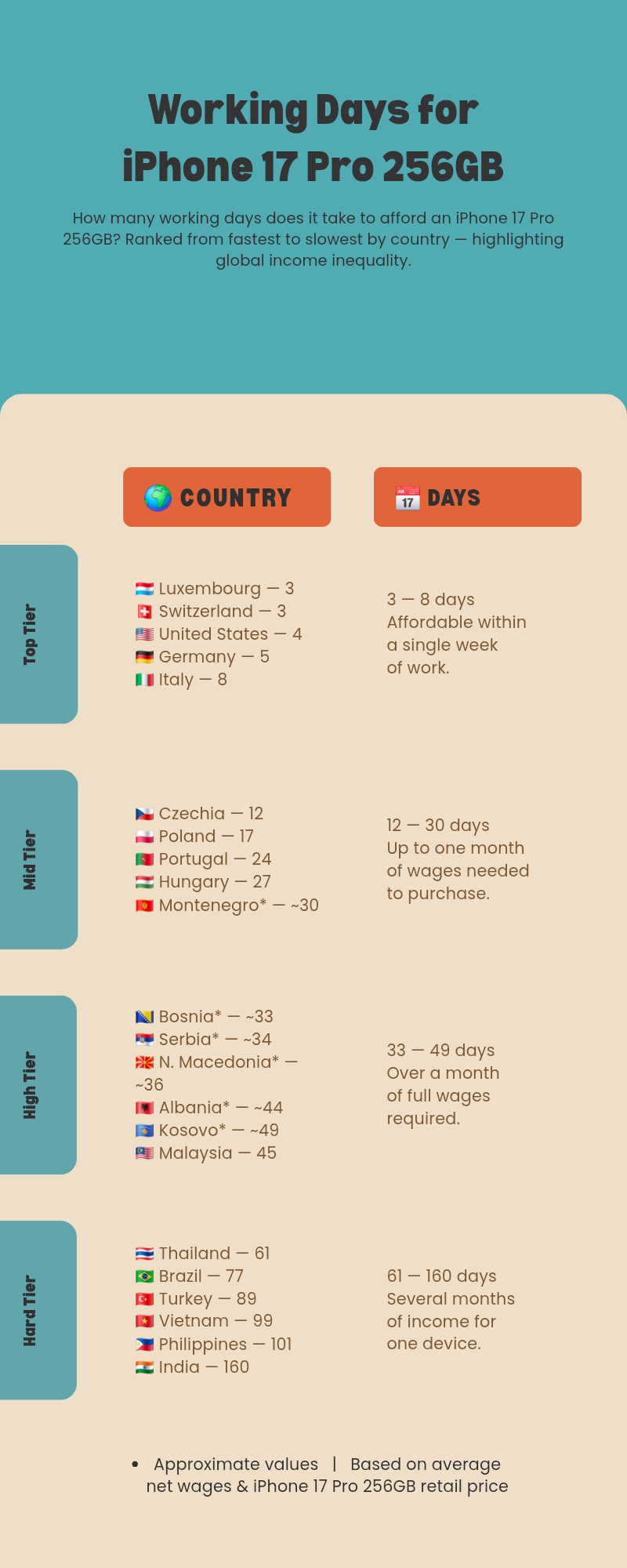
*WB6 figures marked with an asterisk are BalkanView estimates and are not part of Tenscope’s original country ranking. They should therefore be read as indicative rather than directly comparable index values.
The Tenscope study itself found that the global average was about 26 working days. Poland required 17 days, Portugal 24 and Hungary 27, while the figure climbed to 89 in Turkey, 99 in Vietnam, 101 in the Philippines and 160 in India.
One phone, radically different purchasing power
The comparison becomes more revealing when the Western Balkans are placed alongside the European Union.
A Luxembourg employee could theoretically earn the value of the phone more than 10 times over in the amount of working time a typical employee in North Macedonia would need to earn enough for one.
For a Kosovar worker, the gap is wider still.
Kosovo’s official statistics agency reported an average net monthly wage of €636 in 2025, while the average private-sector wage was lower, at €596. A 256-GB iPhone 17 Pro is currently listed by a major Kosovo telecom operator at about €1,450.
On that basis, the handset represents more than two average monthly net salaries in Kosovo before ordinary household expenses are considered.
In North Macedonia, the State Statistical Office reported an average net wage of 43,050 denars in January 2025. A current market listing seen by BalkanView puts a new 256-GB iPhone 17 Pro at around 71,990 denars, producing an indicative affordability estimate of about 36 working days under BalkanView’s methodology.
Montenegro comes closest among the WB6
Among the six Western Balkan economies, Montenegro performs best in BalkanView’s indicative comparison.
Official statistics put Montenegro’s average net salary for 2025 at €1,012 a month, considerably higher than several of its regional neighbours. A 256-GB iPhone 17 Pro is currently offered by a Montenegrin retailer for about €1,419 for a one-off payment.
That translates into roughly 30 full working days — still around six times the five days in Germany and 10 times Luxembourg’s three-day figure.
Bosnia and Herzegovina follows at roughly 33 days in BalkanView’s calculation. The country’s statistics agency put the average monthly net wage at 1,570 convertible marks in 2025, while local retail prices for the phone vary substantially. One current retailer lists the 256-GB model at 2,379 marks.
Serbia comes out at roughly 34 days using a current retail price of around 194,000 dinars and the official December 2025 average net salary of 124,089 dinars. The precise result changes depending on whether an annual average or a particular month’s salary is used, making the figure an approximation rather than a direct extension of Tenscope’s index.
Albania and Kosovo face the steepest burden
Albania and Kosovo sit at the expensive end of BalkanView’s WB6 comparison.
Albania’s fourth-quarter 2025 average gross monthly salary reached 86,984 lek, according to INSTAT, while local prices for the iPhone vary considerably between retailers. Vodafone Albania lists the 256-GB iPhone 17 Pro at 134,990 lek before a current discount, while other retailers advertise significantly lower prices.
That price variation itself matters. Unlike comparisons between official Apple stores in large markets, Western Balkan consumers often buy smartphones through telecom operators, authorised retailers, independent importers or parallel-market sellers. The same model can consequently carry substantially different prices.
Kosovo shows a similar pattern, with current listings ranging from around €1,350 to €1,500 for the 256-GB model.
The headline figure therefore does not mean that every Albanian must literally work 44 days, or every Kosovar 49 days, to purchase the device. Higher earners will need considerably less time; workers below the average will need much more.
And that distinction matters in economies where wage distributions can be uneven.
The real story isn’t the iPhone
The iPhone Affordability Index is ultimately not a story about smartphones.
It is about purchasing power.
Apple sells essentially the same premium product across dozens of economies. Unlike rent, restaurant meals or many local services, whose prices adjust substantially to domestic wages, globally traded electronics are priced within a much narrower international range.
Salaries are not.
That makes the iPhone an imperfect but visually powerful economic yardstick.
The difference between three days in Luxembourg and roughly 30-50 days across the Western Balkans illustrates why nominal wage increases alone do not necessarily make Balkan households feel wealthier.
A salary can rise by 10% or 15%, but what matters to consumers is what that money can actually purchase.
The European convergence problem in your pocket
For Western Balkan governments seeking EU membership, the numbers also illustrate another dimension of European convergence that receives less attention than negotiating chapters and reform benchmarks.
Citizens do not experience convergence through European Commission reports.
They experience it through salaries, housing costs, supermarket bills, cars, holidays — and increasingly through globally priced technology.
An employee in Germany needs around five working days for the phone, according to Tenscope. A worker in North Macedonia may need roughly seven times that amount of labour under BalkanView’s estimate. In Kosovo, the gap approaches tenfold.
The Western Balkans may be geographically surrounded by the European Union, and its consumers may increasingly want the same products and lifestyles as people in richer European economies.
Their purchasing power has not caught up.
And perhaps nowhere is that disparity easier to see than in something millions of people carry in their pockets.