


Tourism in the Balkans is booming, but the numbers reveal a region increasingly divided between mature tourism giants, rapidly emerging destinations and countries that have yet to convert their geographical and cultural potential into a comparable tourism economy.
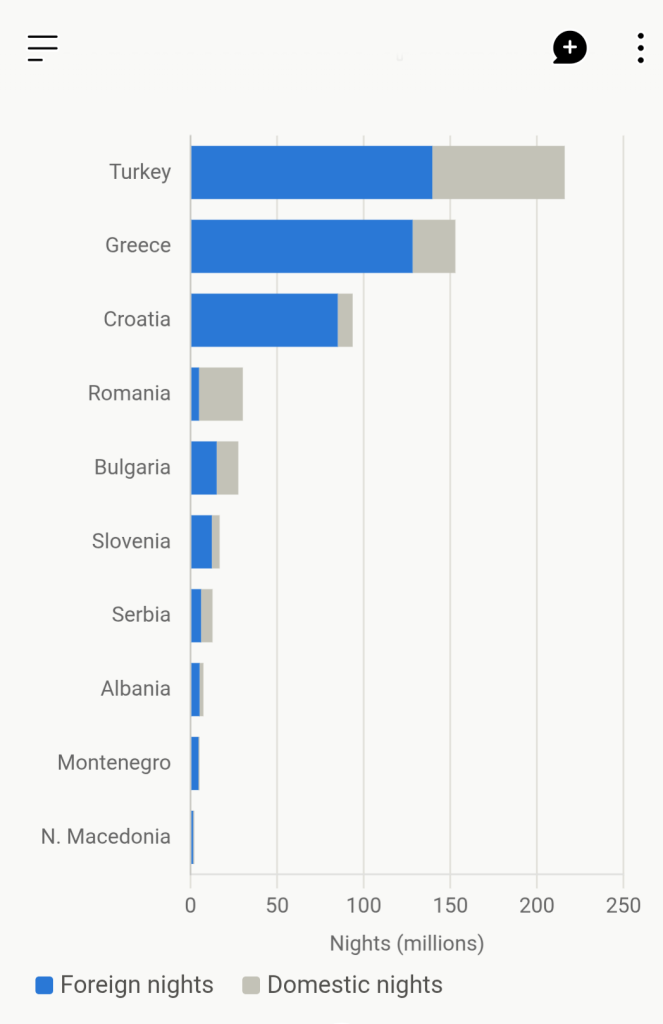
Eurostat data for 2024 show the enormous differences in scale. Greece registered almost 153 million overnight stays in tourist accommodation, Croatia 93.6 million and Bulgaria 27.6 million. Romania recorded 30.2 million, Slovenia 16.8 million and Serbia 12.7 million.
Further south in the Western Balkans, Albania reached 7.45 million nights, Montenegro 5.2 million and North Macedonia just 2.18 million.
Turkey, when included in the broader Balkan tourism market, dwarfs even these figures with more than 216 million overnight stays.
But absolute numbers tell only part of the story. The more revealing indicators are how quickly individual destinations are growing, how dependent they are on foreign visitors and how large tourism has become relative to their resident populations.
Albania is the Balkan outlier
Perhaps the most striking number in the Eurostat dataset is Albania’s growth.
Total nights spent in tourist accommodation increased by 23.9% in 2024 compared with 2023, reaching 7.45 million. Overnight stays by foreign tourists surged by 33.9%, to 5.23 million.
That means roughly 70% of all registered overnight stays in Albania were generated by foreign visitors.
Few numbers illustrate Albania’s transformation as a tourism destination more clearly.
Albania is still far smaller than neighbouring Greece or Croatia in absolute terms, but it is growing from a much lower base and at a dramatically faster pace. Improving air connections, social-media visibility, relatively competitive prices and the rapid development of its Adriatic and Ionian coastline have combined to change its position in the regional market.
The result is that Albania is no longer merely an emerging Balkan destination. It is increasingly becoming a direct competitor for Montenegro and, in some market segments, for Greece and Croatia.
Greece remains the southern Balkan powerhouse
Albania’s growth should nevertheless be placed in perspective.
Greece recorded 152.9 million tourist nights in 2024, more than 20 times Albania’s total and around 70 times that of North Macedonia.
Foreign visitors generated approximately 128.2 million nights, or almost 84% of Greece’s total.
Tourist nights increased by 3.9% from 2023, with foreign nights rising 4.1%.
Those growth rates appear modest beside Albania’s 24%, but this is partly a consequence of scale. Adding several percentage points to a market already exceeding 150 million nights represents millions of additional overnight stays.
The geographical concentration of that tourism is even more striking.
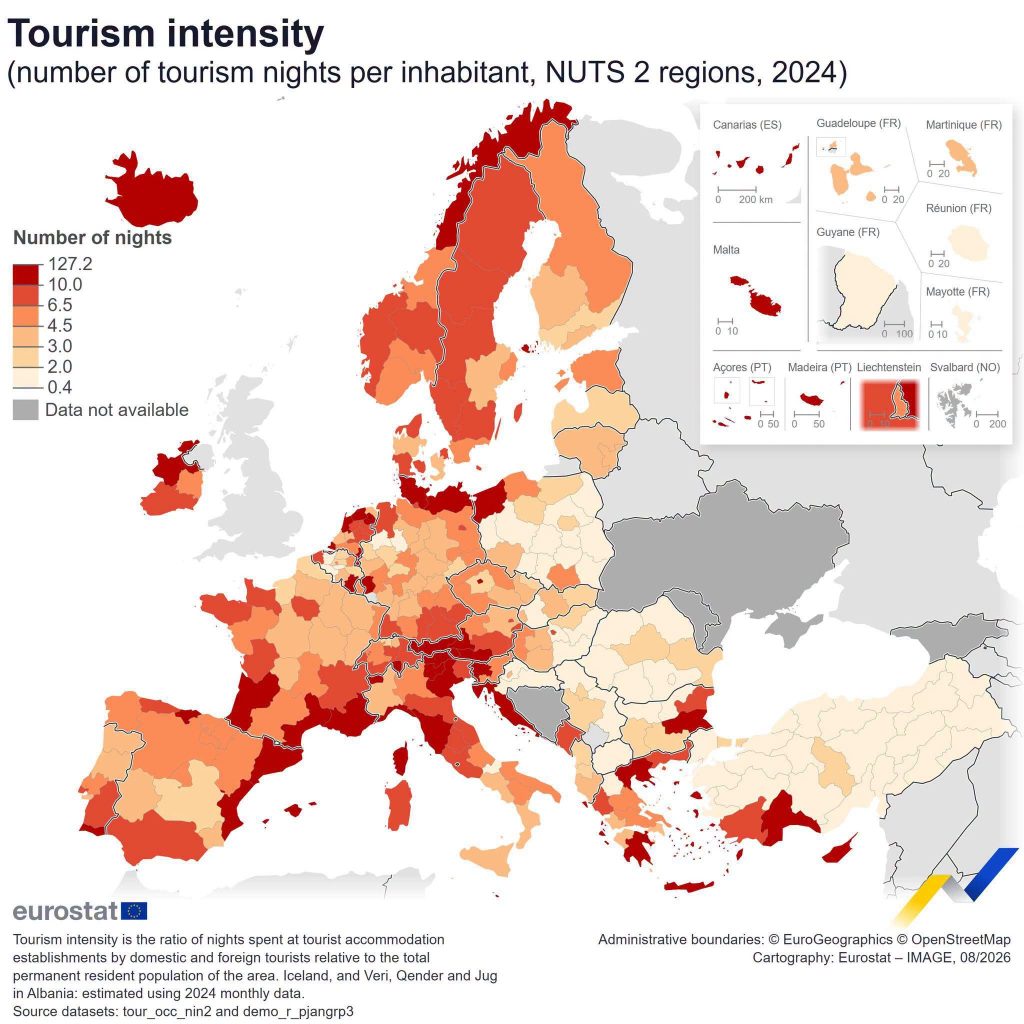
Eurostat’s tourism-intensity indicator — nights spent at tourist accommodation relative to the permanent resident population — shows that the South Aegean (Notio Aigaio) recorded 127.2 nights per inhabitant in 2024, the highest level among EU regions.
Greece’s Ionian Islands recorded 102.6 nights per inhabitant, the second-highest figure. Italy’s Provincia Autonoma di Bolzano/Bozen followed with 68.9.
At the opposite end of the EU ranking were Mayotte in France with 0.5 nights per inhabitant, Poland’s Mazowiecki regionalny with 0.7 and Romania’s Sud-Muntenia with 0.8.
The contrast demonstrates how national tourism statistics can conceal enormous regional pressure.
In some Greek island regions, the number of tourist nights during a year exceeds the resident population more than one hundredfold.
Croatia: a tourism economy of extraordinary intensity
Croatia presents an equally striking picture.
It registered 93.64 million overnight stays in 2024, of which almost 85 million were generated by foreigners.
That means foreign visitors accounted for 90.7% of all tourist nights — the highest foreign-tourist dependence among the Balkan countries in this comparison.
Croatia’s tourism economy is therefore not merely large relative to its population. It is overwhelmingly international.
Total overnight stays still increased by 1.4% in 2024, despite the country’s already mature tourism industry.
Its structure also differs significantly from Greece. Croatia recorded almost 68.1 million nights in holiday and other short-stay accommodation and camping combined, demonstrating the extraordinary importance of apartments, campsites and other non-hotel accommodation along the Adriatic.
That model has produced enormous tourism volumes, but it also creates challenges familiar across the Mediterranean: seasonal labour shortages, housing pressure, congestion, infrastructure requirements and the risk that coastal communities become increasingly dependent on a few months of tourism activity.
Montenegro is even more dependent on foreigners
Montenegro offers perhaps the clearest Western Balkan example of a tourism-dependent small economy.
Eurostat recorded approximately 5.2 million nights in collective tourist accommodation in 2024. Foreign tourists accounted for 4.6 million, or 88.5% of the total.
Domestic tourists generated fewer than 600,000 nights.
The country’s overall tourist nights increased by a relatively modest 1.5% compared with 2023, while foreign overnight stays grew by just under 1%.
This creates an interesting contrast with neighbouring Albania.
Montenegro already has an internationally oriented tourism economy, but Albania is expanding much faster. If current trends persist, Albania’s rapid increase in accommodation capacity and international arrivals could substantially alter competition along the southern Adriatic.
Slovenia has quietly built a strong international market
Slovenia recorded 16.84 million nights in 2024, including 12.34 million by foreign visitors.
Foreign tourists therefore accounted for approximately 73.3% of the total.
Overall overnight stays increased by 4.6%, while foreign nights rose by around 7%.
The Slovenian case is important because it demonstrates that Balkan and Adriatic tourism does not have to depend primarily on mass coastal tourism.
Slovenia has developed a diversified offer based on Ljubljana, Alpine tourism, spas, lakes, gastronomy and nature, creating a tourism economy that is both strongly international and less dependent on one coastal summer season.
Bulgaria and Romania show a different model
Bulgaria recorded 27.65 million overnight stays, an increase of 2.9% over 2023.
Foreign tourists generated 15.06 million nights, representing about 54.5% of the total, while domestic visitors accounted for 45.5%.
Romania presents almost the reverse picture.
Of its 30.23 million nights, around 25.29 million — 83.7% — were generated by domestic tourists. Foreign visitors represented only 16.3%.
Romania consequently has the least internationally dependent tourism economy among the Balkan countries covered here.
The contrast with Croatia is remarkable: foreigners generate more than nine out of every ten tourist nights in Croatia but fewer than two out of ten in Romania.
These are fundamentally different tourism economies even if both record tens of millions of overnight stays.
Serbia occupies the middle ground
Serbia recorded 12.66 million overnight stays in 2024.
The market was almost evenly divided: domestic tourists generated 6.56 million nights and foreigners 6.10 million.
Foreign visitors accounted for 48.2% of the total, compared with 51.8% for domestic travellers.
Growth, however, was weak. Total nights increased by just 1.8%, although foreign nights grew a much healthier 9.2%. Domestic nights declined by 4.3%.
That shift suggests Serbia is becoming more internationally oriented even without the coastal tourism product available to Croatia, Montenegro, Albania or Greece.
Belgrade’s city-break market, festivals, business tourism, spas and mountain destinations give Serbia a substantially different tourism profile.
North Macedonia grows, but the gap remains enormous
North Macedonia presents one of the most interesting contradictions in the regional picture.
It recorded only 2.18 million overnight stays in 2024, the lowest total among the Balkan countries included in this Eurostat comparison.
Yet the underlying trend was positive.
Total overnight stays increased by 5.2%, while foreign tourist nights rose by almost 9% to 1.53 million.
Foreign visitors generated approximately 70.2% of all overnight stays, compared with just under 30% for domestic travellers.
The country is therefore already strongly dependent on international demand, despite the relatively small absolute size of its tourism sector.
That distinction matters.
North Macedonia does not primarily have a problem attracting foreigners rather than domestic visitors. Its problem is scale, connectivity, length of stay and the capacity to turn individual destinations into a larger national tourism product.
Ohrid illustrates both the potential and the limitation.
It is one of the Balkans’ internationally recognisable cultural and lake destinations, but North Macedonia cannot compete with Greece, Albania, Croatia or Montenegro through conventional seaside mass tourism.
Its competitive assets are different: Ohrid, UNESCO heritage, mountains, gastronomy, wine, religious and Ottoman heritage, outdoor tourism and its central geographical position in the southern Balkans.
The strategic objective should therefore not be to reproduce the Croatian or Greek model but to persuade visitors to stay longer and spend more.
The Balkan tourism table
The Eurostat data reveal the scale of the differences:
| Country | Tourist nights 2024 | Foreign nights | Foreign share | Change vs 2023 |
|---|---|---|---|---|
| 🇹🇷 Turkey | 216.0m | 139.6m | 64.6% | +6.3% |
| 🇬🇷 Greece | 152.9m | 128.2m | 83.8% | +3.9% |
| 🇭🇷 Croatia | 93.6m | 85.0m | 90.7% | +1.4% |
| 🇷🇴 Romania | 30.2m | 4.9m | 16.3% | +3.5% |
| 🇧🇬 Bulgaria | 27.6m | 15.1m | 54.5% | +2.9% |
| 🇸🇮 Slovenia | 16.8m | 12.3m | 73.3% | +4.6% |
| 🇷🇸 Serbia | 12.7m | 6.1m | 48.2% | +1.8% |
| 🇦🇱 Albania | 7.45m | 5.23m | 70.3% | +23.9% |
| 🇲🇪 Montenegro | 5.20m | 4.60m | 88.5% | +1.5% |
| 🇲🇰 North Macedonia | 2.18m | 1.53m | 70.2% | +5.2% |
Source: Eurostat, nights spent at tourist accommodation establishments, 2024. Figures cover hotels and similar accommodation, holiday and other short-stay accommodation, and camping grounds (NACE I551–I553).
Albania grows fastest, Croatia and Montenegro depend most on foreigners
Seen together, the figures divide the region into several different tourism models.
Greece and Croatia are the established giants. Their challenge is increasingly not attracting visitors but managing enormous volumes sustainably.
Albania is the disruptor. Its 23.9% increase in overnight stays — driven by a 33.9% surge in foreign nights — stands far above the growth rates of its Balkan competitors.
Montenegro is highly exposed to international demand. Almost 89% of its nights come from foreigners.
Slovenia has developed a smaller but highly international and diversified tourism economy.
Romania remains primarily a domestic tourism market, despite recording more total overnight stays than Bulgaria.
Serbia is moving gradually towards greater internationalisation.
And North Macedonia is growing faster than most mature Balkan markets, but from a very low base.
There is another important conclusion: the number of tourists alone is increasingly insufficient for understanding what is happening.
Three indicators need to be read together — total nights, the foreign/domestic composition of those nights and tourism intensity relative to the local population.
For a country such as North Macedonia, the challenge is increasing volume and length of stay. For Albania, it is managing extremely rapid expansion. For Montenegro and Croatia, it is reducing the vulnerabilities created by overwhelming dependence on international tourism. For Greece, especially its islands, it is managing tourism intensity that has reached extraordinary levels.
The Balkans have largely won their battle to become visible on Europe’s tourism map.
The next competition will be harder. It will be about who can turn visitors into greater economic value without allowing tourism itself to undermine the destinations that made the visitors come in the first place.