


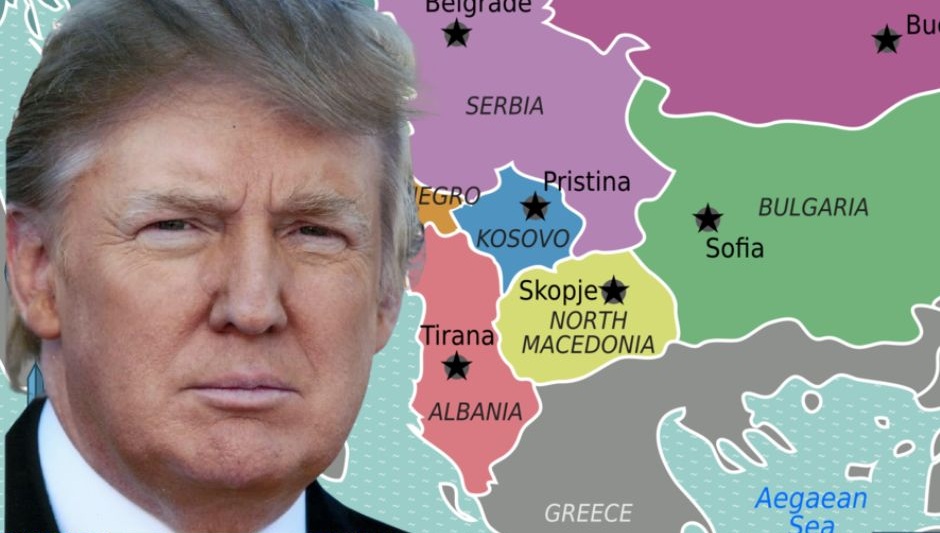
Washington signals continued focus on sovereignty, democratic governance and sanctions enforcement across the region
WASHINGTON, June 24 (BV)— U.S. President Donald Trump has extended for another year the national emergency relating to the Western Balkans, maintaining a sanctions framework that allows Washington to target individuals accused of undermining peace agreements, threatening regional stability, engaging in corruption or evading U.S. sanctions.
In a notice published in the Federal Register, the White House said the situation in the Western Balkans continues to pose an “unusual and extraordinary threat” to U.S. national security and foreign policy interests.
The measure traces its origins to 2001, when the United States declared a national emergency in response to extremist violence in what is now North Macedonia and efforts to obstruct the implementation of the Dayton Peace Agreement in Bosnia and Herzegovina and UN Resolution 1244 on Kosovo.
Over the years, successive U.S. administrations expanded the scope of the sanctions regime. A major revision came in 2021, when Washington widened the framework to include corruption, attacks on democratic institutions and actions undermining post-war agreements across the region. Additional measures adopted in 2025 targeted individuals accused of challenging the sovereignty and territorial integrity of Western Balkan states and those seeking to circumvent existing U.S. sanctions.
Message to the region
The extension does not indicate a new crisis but confirms that Washington continues to view unresolved political disputes, corruption and institutional weaknesses as strategic security concerns.
The decision affects all six Western Balkan countries — Albania, Bosnia and Herzegovina, Kosovo, Montenegro, North Macedonia and Serbia — as well as individuals and entities operating within or connected to the region.
For regional leaders, the move serves as a reminder that U.S. policy remains closely linked to the preservation of the post-conflict order established after the breakup of Yugoslavia and to support for Euro-Atlantic integration.
Bosnia remains a key concern
Although the declaration applies to the entire region, Bosnia and Herzegovina remains one of Washington’s primary concerns.
U.S. officials have repeatedly warned against efforts to weaken state institutions, challenge the Dayton framework or increase separatist rhetoric. Several Bosnian political figures have already been sanctioned under existing authorities.
The continuation of the emergency signals that Washington sees those risks as unresolved.
Kosovo-Serbia tensions still under scrutiny
The reference to UN Security Council Resolution 1244 highlights continued American attention to relations between Kosovo and Serbia.
Despite ongoing EU-led dialogue efforts, normalization remains incomplete, while periodic tensions in northern Kosovo continue to raise concerns among Western partners.
The extension reinforces the message that actions undermining regional stability could trigger U.S. sanctions.
Corruption elevated to a security issue
Perhaps the most significant evolution of the emergency framework is the treatment of corruption as a national security concern.
Under the expanded authorities, individuals involved in significant corruption, abuse of public office or efforts to undermine democratic institutions can face asset freezes and restrictions on access to the U.S. financial system.
This approach has already affected politicians, business figures and public officials across the region.
North Macedonia and the wider integration agenda
For North Macedonia, the extension comes at a sensitive moment as the country remains blocked in its EU accession process because of the constitutional amendments required under the 2022 negotiating framework.
While the U.S. declaration does not directly address the dispute with Bulgaria, it underlines Washington’s broader support for democratic governance, institutional reforms and Euro-Atlantic integration.
The decision also comes as the European Union seeks to revive enlargement momentum, with Montenegro and Albania advancing in accession talks and Brussels increasingly viewing the Western Balkans through a geopolitical lens.
Strategic signal
The annual renewal is largely procedural, but politically significant.
At a time when Russia, China, Türkiye and Gulf countries are expanding their influence in Southeast Europe, Washington is signalling that the Western Balkans remain part of its strategic security agenda.
The message from the White House is clear: stability, implementation of post-war agreements, democratic governance and the fight against corruption remain essential conditions for the region’s future integration into Euro-Atlantic structures.