


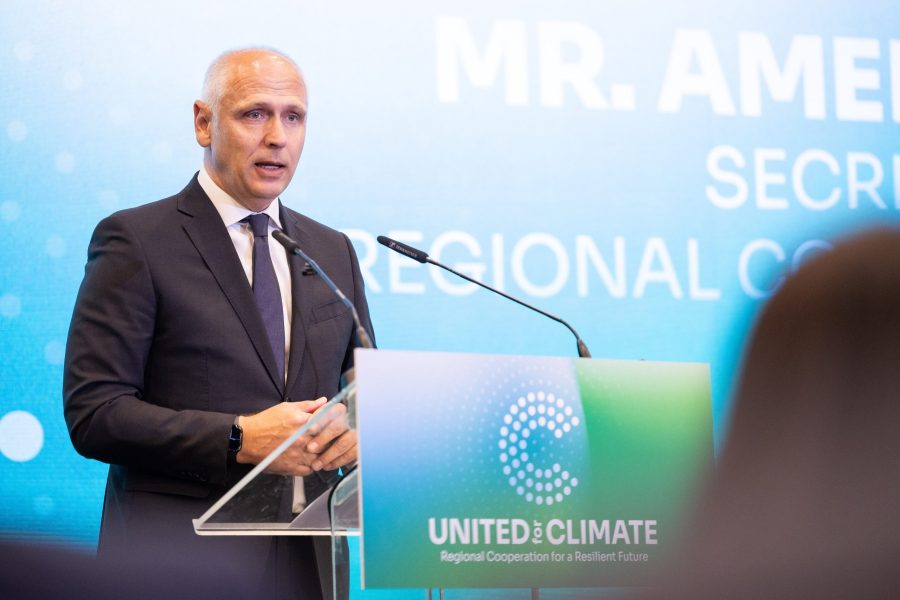
Climate adaptation in the Western Balkans must move from strategy to concrete, coordinated and bankable investments, the Secretary General of the Regional Cooperation Council (RCC) Amer Kapetanović said on Monday, warning that climate impacts increasingly threaten economies and public finances across the region.


“Every new flood, drought, wildfire or landslide is also a budgetary shock, redirecting public money from schools, hospitals, roads and energy transition toward repairing damage,” he said.
The conference, organised by Albania’s Ministry of Tourism and Environment and Germany’s GIZ within the Regional Climate Partnership framework, gathered ministers, officials and experts from across the Western Balkans Six (WB6), alongside international organisations and financial institutions.
Kapetanović warned that climate impacts are already intensifying across the region, citing frequent wildfires, floods, droughts and heatwaves. He recalled that floods in 2014 caused around 1.7 billion euros in damages in Serbia and affected about one million people in Bosnia and Herzegovina.
According to World Bank estimates, the WB6 will need at least 37 billion dollars in climate adaptation investments over the next decade, he added.
“Climate impacts do not stop at borders, and neither can our response,” Kapetanović said, calling for stronger regional coordination and investment-driven approaches.
He outlined RCC initiatives aimed at strengthening resilience, including the WB6 Climate Adaptation Strategy 2026–2030, a regional biodiversity plan, and the exploration of a regional risk insurance mechanism.
Discussions at the conference focused on closing the climate investment gap and improving hydrometeorological services and data systems to support early warning and evidence-based decision-making.