



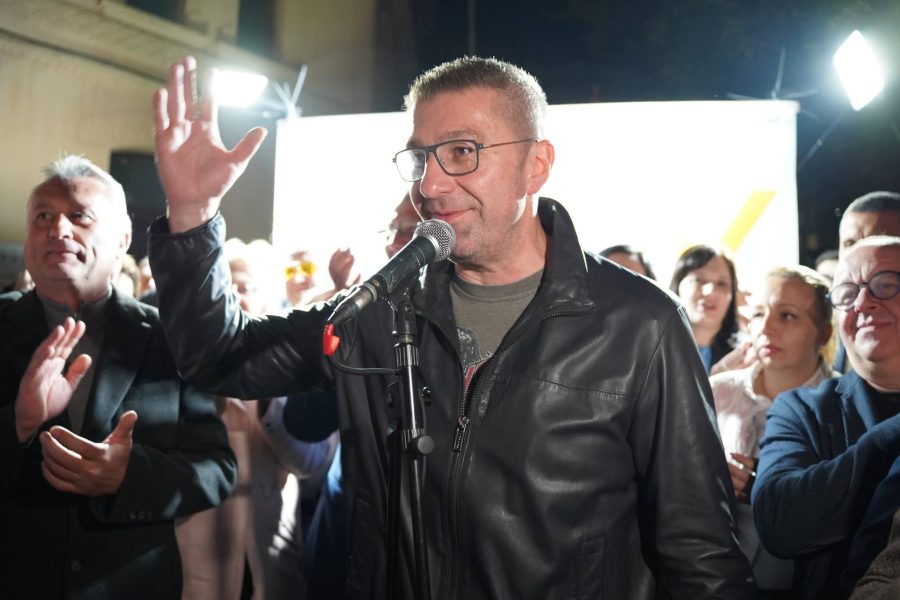
North Macedonian Prime Minister Hristijan Mickoski said on Thursday that he has no objection to the use of the Albanian language, emphasizing that he is even trying to learn it. “The more languages I know, the richer I am,” he told lawmakers in parliament.
Mickoski’s remarks came during a parliamentary session responding to a question from Skender Redzepi of the European Front party about language use, fair representation, and allegations that the government, amid economic and political challenges, “daily raises ethnic issues.”
“Feel free to use Albanian,” Mickoski said. “I am trying to learn it myself. No language bothers me, and it will not.” He stressed, however, that Macedonian, along with its Cyrillic script, remains the official language across the country, while local minority languages are used in municipalities where more than 20% of the population belongs to a minority community.
The session highlighted ongoing sensitivity around language rights in North Macedonia, a legacy of ethnic tensions that erupted into armed conflict in 2001 between government forces and ethnic Albanian insurgents. That conflict ended with the Ohrid Framework Agreement, which guaranteed greater rights and representation for ethnic Albanians in state institutions, including language use in administration and education.
Mickoski also noted that the Law on Fair Representation – which enshrines the principles of the Ohrid Agreement – is expected to reach parliament soon after passing all institutional procedures and receiving a positive opinion from the Venice Commission. “I hope lawmakers will support it. This law is constitutional, not unconstitutional, as the coalition of Mr. Redzepi allegedly misled Albanians in North Macedonia about for over 20 years,” he said.
The debate over language rights has been reignited by several incidents in Tetovo, including a recent visit by Education Minister Vesna Janevska to the Moša Pijade school, where a journalist asked whether she had brought a translator. Mickoski and the government reiterated that Albanian translation services are available in parliament, but that public discourse must remain professional and dignified.
The Association of Journalists of Macedonia (ZNM) urged respect for the journalist code of ethics, emphasizing that public communication must adhere to professional standards and that such debates should not be exploited for political gain or to inflame ethnic tensions.
Mickoski concluded that while he personally supports learning and using multiple languages, Macedonian remains the official language throughout the country, in line with the constitution and the provisions of the Ohrid Agreement.
The 2001 conflict in North Macedonia involved clashes between ethnic Albanian rebels and Macedonian security forces, resulting in more than 100 deaths and thousands displaced. The Ohrid Framework Agreement, brokered by the EU and the U.S., ended the conflict by granting greater language rights, proportional representation in state institutions, and decentralization to accommodate ethnic Albanian communities. Despite formal implementation, language and minority rights remain politically sensitive issues, often resurfacing in parliamentary debates.