


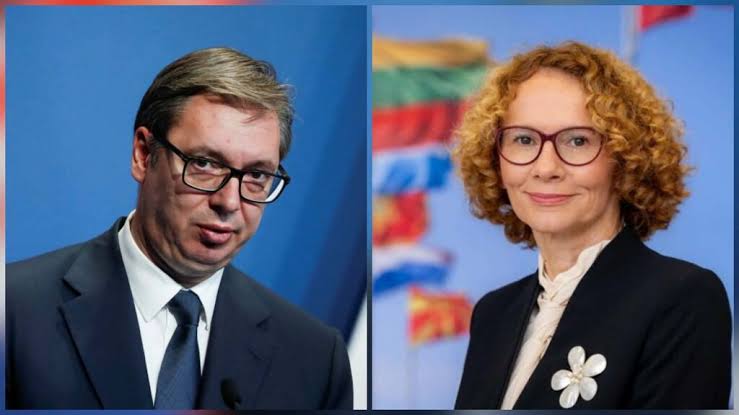
Serbian President Aleksandar Vucic’s criticism of senior NATO official Radmila Shekerinska reflects messaging primarily intended for a domestic audience rather than a shift in relations with North Macedonia, regional analysts said.
Vucic reacted after Shekerinska, NATO’s deputy secretary-general, called for continued dialogue between Serbia and Kosovo and warned that divisive rhetoric in the Western Balkans undermines stability.
Security experts said her remarks represented NATO’s collective position and were not directed at North Macedonia as a state.
“It is unnecessary to draw our country into such a debate,” said to DW Zlatko Kuzmanov, a security studies expert, adding that the statements were made “on behalf of all 32 NATO members” and should not affect Skopje’s relations with Belgrade or other regional capitals.
Analysts said Vucic’s response was shaped partly by how regional media — particularly in Croatia — framed Shekerinska’s comments, prompting him to react to avoid appearing passive before the Serbian public.
Others interpreted the exchange more critically, arguing that Vucic used the moment to reinforce longstanding narratives.
“In political terms, this allows him to address NATO, neighbouring countries that supported Kosovo’s independence, EU pressure for dialogue with Pristina, and even the domestic opposition — all at once,” political analyst Saso Ordanoski said to DW.
Shekerinska said NATO wants the Western Balkans to “project peace, stability and prosperity,” but warned that certain rhetoric in the region fuels divisions and, in some cases, secessionist discourse.
Vucic, who said Shekerinska at times “speaks about things that do not make much sense,” suggested her comments referred to Bosnia’s Serb entity, Republika Srpska. He also linked her position to Western support for Kosovo’s independence, which Serbia rejects.
Despite the sharp tone, analysts largely agreed the episode is unlikely to disrupt bilateral relations.
They noted that Serbia continues to face growing international pressure to normalise ties with Kosovo, an issue that remains politically sensitive in Belgrade.
Vucic also expressed concern over a defence cooperation declaration signed last year by Croatia, Albania and Kosovo, although NATO said it had not been involved in consultations on the initiative and does not oppose additional defence arrangements among partners.
Officials in Skopje did not respond publicly to Vucic’s remarks. The government’s silence was interpreted by observers as an effort to avoid escalating rhetoric.
“The region’s complex political and security environment, combined with incomplete Euro-Atlantic integration, leaves room for leaders to interpret such statements differently,” Kuzmanov said.
Analysts added that such exchanges are characteristic of the Western Balkans’ fragile political landscape, where international statements are often filtered through domestic political considerations rather than signalling substantive policy change.