



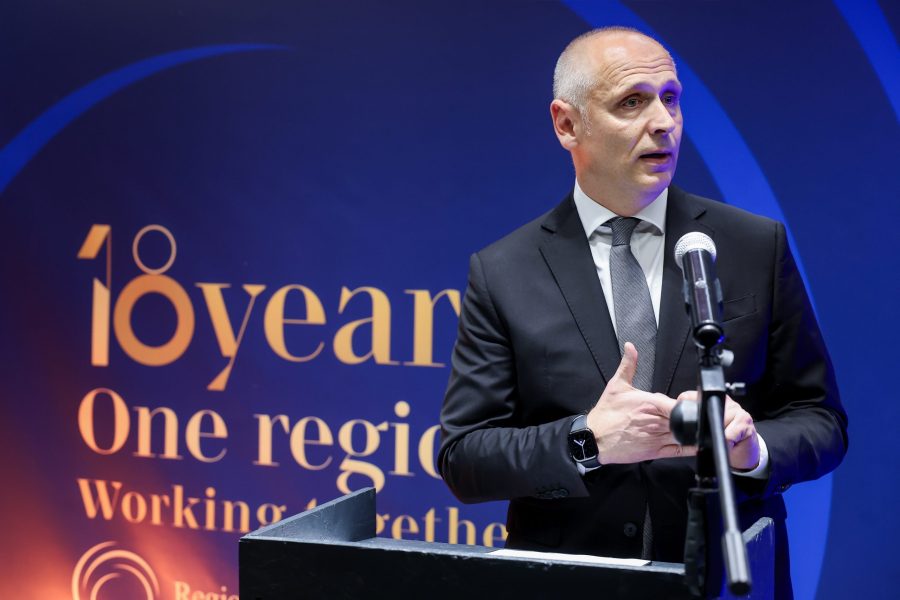
The Regional Cooperation Council (RCC) marked the 18th anniversary of its establishment with an annual reception in Sarajevo, reaffirming its role as a central platform for regional cooperation in South East Europe amid geopolitical uncertainty and polarization.
The event brought together partners, representatives of RCC participants, international organisations, and members of the diplomatic community. Officials said the anniversary offered a moment to reflect on nearly two decades of institution-building and to restate the organisation’s commitment to adapting to a rapidly changing international environment.
The RCC was formally launched on Feb. 27, 2008, at a meeting of the South East European Cooperation Process (SEECP) in Sofia, as the successor to the Stability Pact for South East Europe. Initially conceived as a mechanism to foster cooperation in the post-conflict Western Balkans, it has since evolved into a regional hub covering economic, security, social, and political cooperation.
Over the years, the RCC’s mandate has expanded beyond facilitation, positioning it as a catalyst of the Berlin Process and as a platform for translating political commitments into concrete regional initiatives. Flagship frameworks include the Common Regional Market, the Green Agenda for the Western Balkans and the South East Europe 2030 Strategy, all aimed at supporting reform, connectivity, and sustainable growth.
Addressing guests at the reception, RCC Secretary General Amer Kapetanović framed the anniversary within a broader arc of regional milestones.
“This year, we mark thirty years of the SEECP, eighteen years of the RCC, twenty years of CEFTA and CEI, and ten years of RYCO. These anniversaries matter because they signal continuity,” Kapetanović said. “The RCC comes of age in a different world than it was 18 years ago and we are fully aware of the challenges ahead. But we are ready to adapt, with clarity and purpose.”
He said the organisation would sharpen its focus on “people-oriented deliverables,” safeguard mutual trust among partners, and use its convening power to sustain structured and inclusive dialogue across the region.
“In times of polarization, keeping all regional actors engaged is not symbolic – it is essential,” he said, adding that efficiency should be measured not by speed “at any cost,” but by focus, credibility and durable implementation.
As the operational secretariat of the SEECP, which brings together 13 participants from South East Europe, the RCC provides institutional backing and political space for sustained regional cooperation.
Officials highlighted tangible achievements over the past 18 years, including the roaming-free regime within the Western Balkans, a reduction of up to 99% in roaming charges between the Western Balkans and the European Union, freer movement using ID cards, mutual recognition of academic and professional qualifications, and coordinated implementation of the Green Agenda.
Beyond project implementation, the RCC has developed regional policy tools used by governments and international partners, including the annual Balkan Barometer survey of public and business opinion, SecuriMeter – a regional security perception index – and the Western Balkans Employment Observatory.
The RCC Board comprises 25 participants, including 14 European Union member states and five G20 countries, reflecting the broader European and international relevance of South East Europe. Headquartered in Sarajevo, with a liaison office in Brussels, the organisation acts as a bridge between regional priorities and international decision-making.
Marking its 18th year, the RCC said it would continue to promote regional cooperation as a strategic choice rooted in shared responsibility and long-term vision, rather than a response to external pressure.