


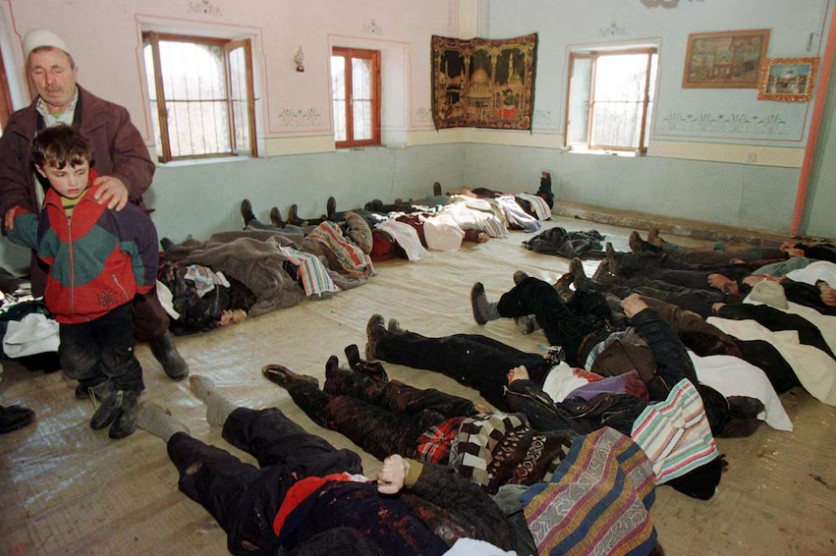
An ethnic Albanian grandfather shows the bodies of at least 40 Racak villagers to his grandchild, whose father is among the victims. (Reuters)
Serbian authorities on Tuesday strongly rejected allegations by Kosovo officials regarding the 1999 Račak military action, calling claims that Serbian forces committed a massacre of civilians “fabricated” and politically motivated.
The Serbian so-called Office for Kosovo and Metohija issued a statement saying that Kosovo Prime Minister Albin Kurti continued a systematic campaign to distort facts about Račak, aiming to obscure what it called the “truth” behind the events.
The statement cited the findings of Serbian investigative judge Danica Marinković, who oversaw the case. According to Marinković, Račak was a stronghold of armed members of the so-called Kosovo Liberation Army (KLA), and casualties on Jan. 15, 1999, occurred during clashes with security forces, not among civilians.
“That truth will remain permanently recorded, despite blatant attempts by Pristina to present these events differently,” the statement said.
Belgrade accused Western actors of using the Račak narrative to justify NATO’s 1999 intervention in the Federal Republic of Yugoslavia. The statement noted that no one has been held accountable for crimes against Serbs by KLA fighters in locations such as Staro Gracko, Livadice, and along the Bistrica River. More than 550 Serbs remain missing, it added.
Kosovo President Vjosa Osmani and Prime Minister Kurti, marking the 27th anniversary of the Račak operation, reiterated allegations that Serbian forces committed war crimes against ethnic Albanians. Osmani described the events as evidence of a genocidal intent by Serbia at the time.
Marinković, speaking to Serbian media, dismissed these claims as false, emphasizing that the operation was a planned anti-terrorist action targeting armed KLA fighters. She said her team documented the presence of KLA members and found no evidence of a massacre of unarmed civilians.
The Račak incident served as the pretext for NATO airstrikes on Yugoslavia in March 1999. Marinković noted that international observers, including the head of the OSCE verification mission William Walker, presented a narrative that mischaracterized the conflict, while preventing Serbian investigators from accessing the site immediately after the operation.
According to the Serbian investigation, the KLA had established fortified positions in Račak, including improvised bunkers and trenches, and engaged security forces using firearms, mortars, and rocket launchers. Serbian police recovered weapons and ammunition from the site.
Serbian authorities also criticized Western leaders, including U.S. President Bill Clinton, Secretary of State Madeleine Albright, and British Prime Minister Tony Blair, for using Račak to justify military intervention, and stated that subsequent investigations, including those by the Hague Tribunal, ultimately neglected these disputes.