


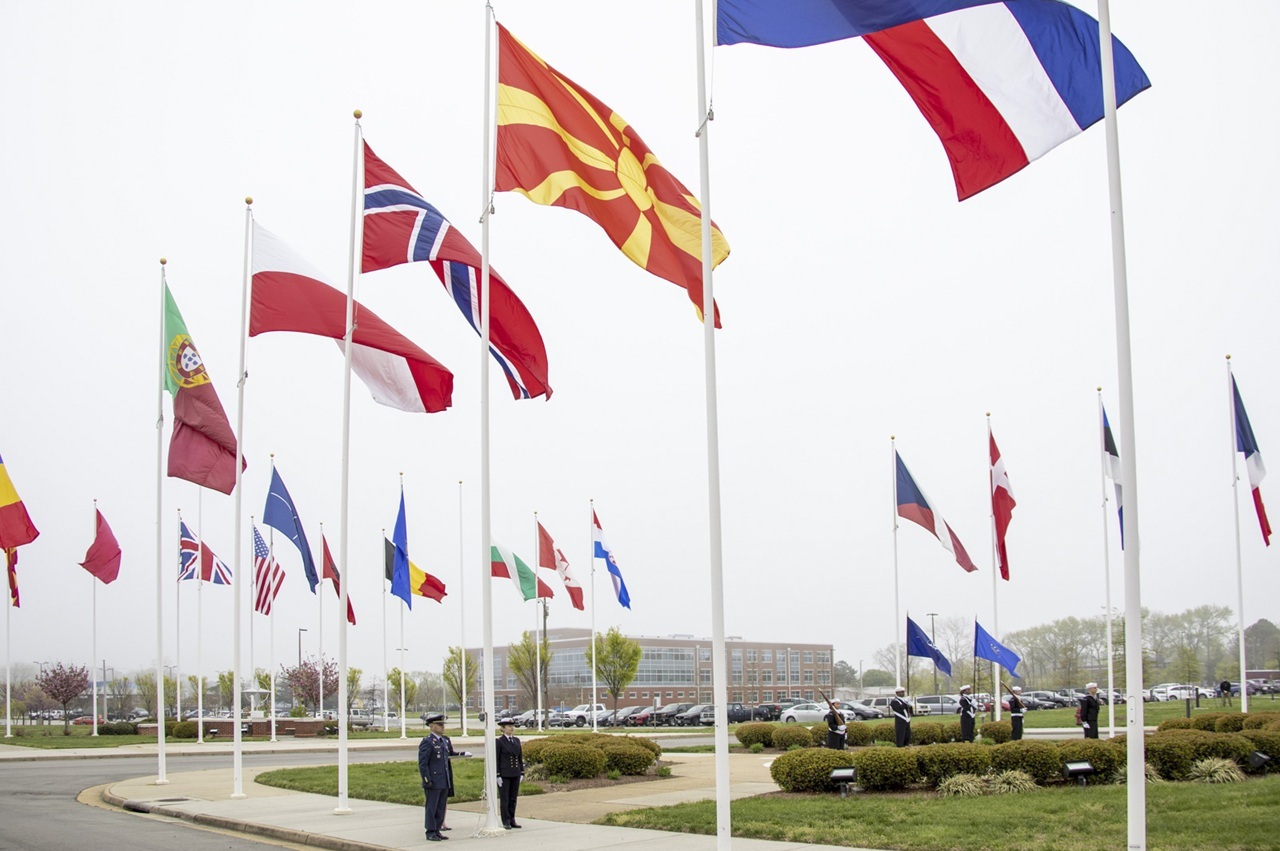
When North Macedonia joined NATO as its 30th member in March 2020, it closed a nearly three-decade chapter marked by regional disputes, internal conflict and demanding reforms, while opening another defined by deeper integration into the Alliance’s security, political and institutional architecture.
The accession, completed just days before the alliance marked its 71st anniversary, reshaped not only the country’s foreign and security policy but also the inner workings of its defence, intelligence and security institutions, according to former officials, lawmakers and independent experts.
“If we were to describe it in one sentence, we could say that the journey was very long, full of challenges and expectations, but in the end it was completed thanks to strong political will and determination – both of the political establishment and of the citizens – for it to finally happen,” said Slavjanka Petrovska, a former defence minister and now a lawmaker from the Social Democratic Union of Macedonia (SDSM).
North Macedonia’s NATO ambition dates back to the early 1990s, shortly after independence from the former Yugoslavia. Trajan Gocevski, the country’s first defence minister, said the strategic direction was set early on.
“These were long 28 years, but we followed a well-defined corridor established back in 1992,” Gocevski said. “That Euro-Atlantic corridor led us to this process, which for the Republic of North Macedonia represents a key foundation for long-term stability.”
Obstacles and turning points
The road was repeatedly blocked by political and security crises. The long-running name dispute with Greece kept the country outside NATO and the European Union for years, while internal tensions culminated in an armed conflict in 2001.
“As the main obstacle, I would mention the open dispute with Greece, which we had for many years and which was a barrier to our accession,” Petrovska said. “At the same time, other societal processes were taking place that made this goal seem very distant.”
She said the 2001 conflict was a “serious internal shock,” but added that the Ohrid Framework Agreement, which ended the fighting, demonstrated that the country could move forward through compromise and institutional reform.
Intelligence and security overhaul
Beyond diplomacy, NATO membership required a deep transformation of the intelligence and security sector, including strict standards on professionalism, accountability and interoperability.
Preparation began years before accession, said Diana Golubova, a former employee of the Intelligence Agency.
“All state institutions – including the services and the Intelligence Agency – were preparing for accession,” Golubova said. “By becoming a NATO member, the Intelligence Agency became part of the Alliance’s structures, specifically the Civil Intelligence Committee.”
Before full cooperation could begin, the agency had to align its procedures with NATO requirements on physical and information security, she added, including vetting, classification systems and secure facilities.
Metodi Hadji Janev, a university professor specialising in security studies, said the reforms were especially important given the broader geopolitical context.
“They are significant because they balance the protection of human rights with the protection of national security,” he said.
Petrovska said NATO membership increased both the volume and quality of communication between North Macedonia’s services and their counterparts across the alliance.
“At the same time, the introduction of rules and procedures within the services themselves significantly improved their functioning,” she said.
Golubova said NATO standards elevated intelligence work to a “higher level,” particularly in access to classified information, which now depends on special security clearances and continuous vetting.
Reforms beyond accession
Experts say the reform process did not stop with accession. Instead, NATO membership accelerated further institutional change and a process of mutual learning.
Ljubcho Prendjov, a lawmaker from the conservative VMRO-DPMNE party, said security culture had improved markedly.
“Today, every individual who applies for a security clearance undergoes additional NATO checks, with the participation of several member states,” he said. “Every system we have must be integrated in accordance with NATO standards.”
However, concerns remain. Dimitar Nikolovski, executive director of the Eurothink think tank, warned of political interference.
“One of NATO’s standards is the depoliticisation and professionalisation of employees,” he said. “Unfortunately, over the past year we have witnessed an intrusion of political parties into the security and intelligence sector, which does not align with NATO standards.”
Transparency, rights and oversight
Membership also pushed reforms related to transparency, gender integration and human rights. While access to classified information remains limited, analysts say public debate and democratic oversight have expanded.
“NATO membership has raised the standards of what transparency and trust in the intelligence and security sector mean,” Nikolovski said, pointing to stronger safeguards for human rights and privacy.
Journalist Miomir Serafinović said NATO benchmarks helped improve oversight of security institutions, even if progress remains uneven.
“We are not yet at the level of other member states, especially in oversight,” he said. “But there has been positive movement, primarily in increasing trust.”
Rights, obligations and influence
As a NATO member, North Macedonia participates in collective decision-making while assuming obligations, including defence spending targets.
“We are NATO partners,” said Prendjov. “We learn from the founding states – the United States, the United Kingdom, France – which have long-established democratic and governance practices.”
Hadji Janev said North Macedonia can contribute to updating NATO’s standards on emerging threats, but must also adapt fully to existing ones.
“The role is twofold: to contribute and to accept the standards established by NATO,” he said.
Defence spending remains a sensitive issue. Abdulmenaf Bedjeti, a university professor, said current spending of around 2% of GDP may need to rise.
“One percent amounts to around 120–130 million euros annually,” he said. “Short-term, this poses a fiscal risk, but the benefits outweigh the risks.”
Former lawmaker Ismet Ramadani said even small members have leverage within the alliance.
“North Macedonia does not have major political or military power in NATO,” he said. “But it has the right of veto, just like the strongest members.”
He also pointed to the appointment of Radmila Šekerinska as NATO’s deputy secretary general as an additional source of influence.
Stability and economic impact
Experts say NATO membership has delivered political and macroeconomic stability, helping attract foreign investment.
“The greatest benefit is stability,” Bedjeti said. “Without it, there can be no success.”
Between 2020 and 2023, North Macedonia attracted about 2.1 billion euros in foreign direct investment, even during the COVID-19 pandemic, Bedjeti said, mainly from NATO and EU countries.
Economic growth also accelerated, averaging 2.8–3% annually after 2020, compared with 2.1% in the two decades before, while around 80% of exports now go to NATO member states.
Security guarantees, including air defence and access to advanced technology, are another key benefit, experts say.
“With ten annual budgets, we could not buy a plane,” Bedjeti said. “The benefits, including air defence, are enormous and priceless.”
New threats, shared responses
NATO membership has also expanded North Macedonia’s capacity to respond to hybrid and non-conventional threats.
Petrovska said joint exercises with allied countries and NATO teams test the country’s ability to respond to a wide range of risks.
“Today it is not only physical security at stake,” she said. “Hybrid threats can be invisible but equally dangerous.”
As global security becomes more volatile, officials say alliance membership is essential.
“For us, NATO represents a strategic commitment,” Prendjov said. “As a small nation, it is important to share democratic values, peace and security.”
Gocevski said membership remains a key stabilising factor.
“The stability of our state will depend on how many alliances we are part of, how we maintain relations with them and how trusted a partner we are,” he said. “Alone, in the long run, it is difficult to endure.”