



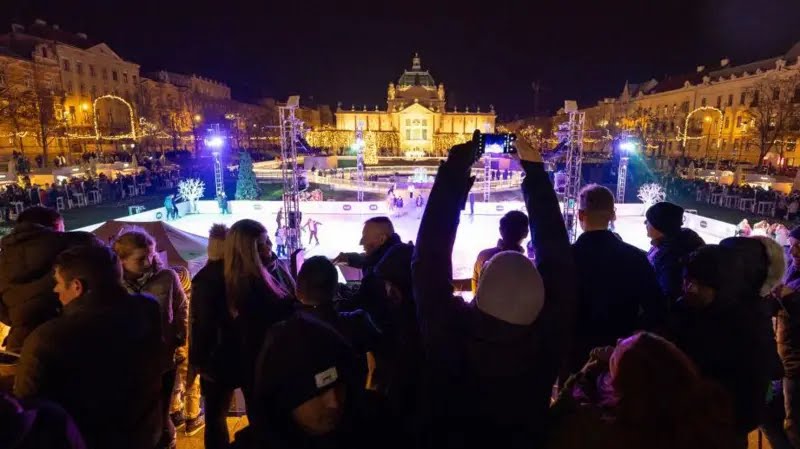
Croatia is betting on festive tourism to reduce its heavy dependence on the summer season, with Zagreb’s Christmas market emerging as a key driver of winter visitor growth, the BBC reported.
Branded as Zagreb Advent, the capital’s sprawling Christmas market has become central to the government’s strategy to reposition Croatia as a year-round tourism destination, drawing visitors well beyond the Adriatic coast and peak summer months.
Tourism accounts for more than a fifth of Croatia’s economy, making seasonal volatility a long-standing vulnerability. “We are developing as a year-round tourism destination – we are not a summer destination anymore,” Tourism Minister Tonci Glavina told the BBC.
Unlike traditional single-site markets elsewhere in Europe, Zagreb Advent spans multiple locations across the city centre, featuring themed venues, food stalls, music stages, art installations and a large outdoor ice rink.
Organisers say the diversity of locations and programming sets Zagreb apart in an increasingly competitive European Christmas market landscape. “The entire city has become a festive ground throughout December,” Slavica Olujic Klapcic, who manages one of the market areas, told the BBC.
The strategy has delivered tangible economic results. According to data cited by the BBC, overnight stays in Zagreb during December more than doubled from about 100,000 in 2014, when the market was launched, to more than 245,000 in 2024, generating an estimated €100 million ($117 million) economic boost.
Zagreb Advent was voted Europe’s best Christmas market for three consecutive years from 2015 to 2017 by travel website European Best Destinations, helping raise the city’s international profile.
Despite its success, Zagreb still trails Europe’s largest Christmas markets. Cologne is expected to attract around four million visitors this year, while Vienna draws about 2.8 million and Strasbourg around two million, the BBC reported.
Tourism experts caution that Croatia’s broader reliance on summer travel remains a structural weakness. Marko Peric, dean of the Faculty of Tourism at the University of Rijeka, told the BBC that winter tourism needs to be expanded beyond Zagreb through gastronomy, cultural festivals and sporting events.
Glavina said early signs of progress were visible, noting that visitor numbers in July and August were slightly lower than last year, while arrivals increased by about 5% in June and September and rose 10% in early December.
“We are transforming Croatia to be a sustainable tourism destination,” he said, according to the BBC, adding that balancing peak and off-season demand was key to long-term growth.
For now, Zagreb Advent stands as a flagship example of that shift – offering Croatia a winter draw to complement its summer sun-and-sea appeal.