


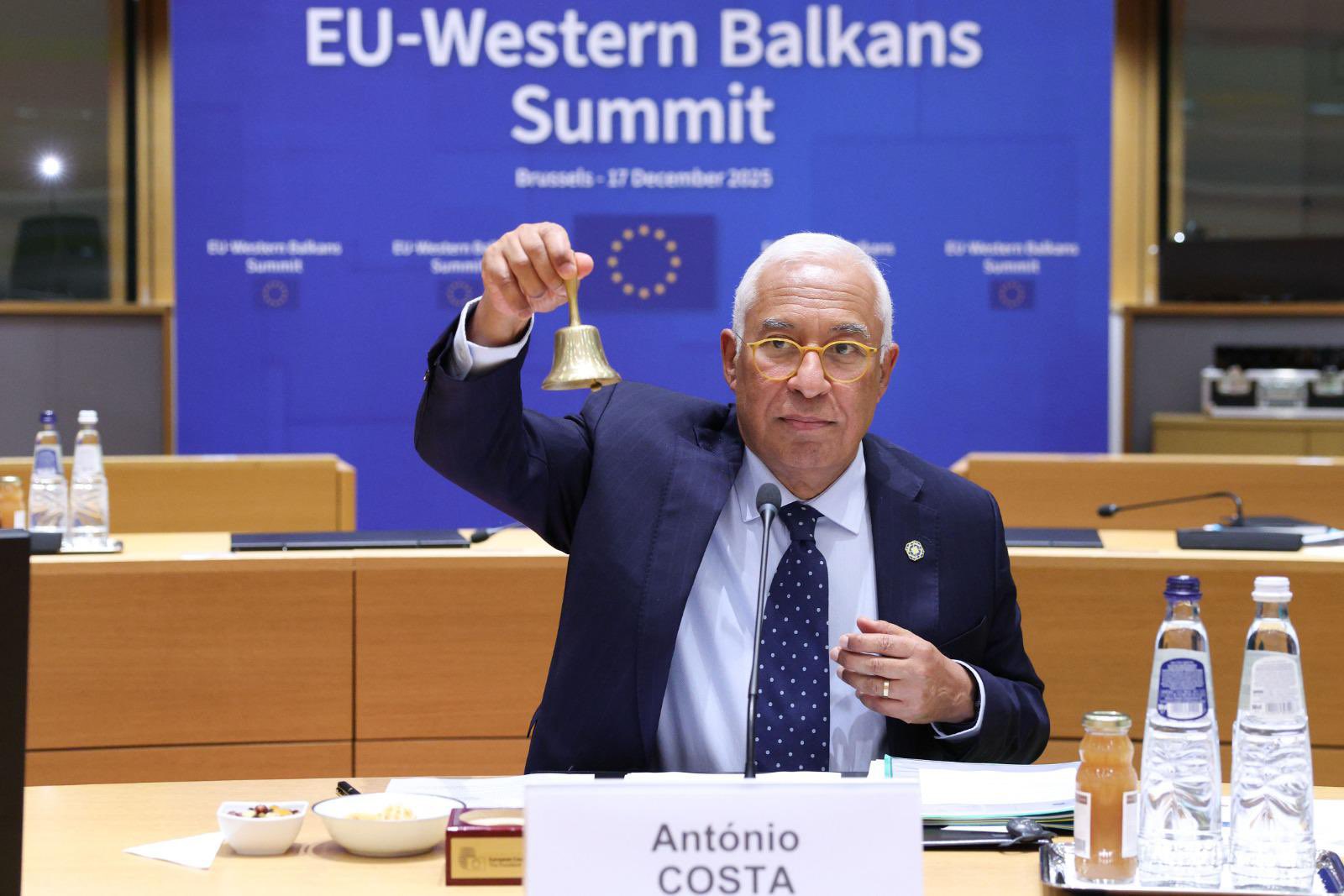
European Union leaders used a summit with Western Balkan partners on Tuesday to reaffirm that enlargement remains firmly on the bloc’s agenda, while making clear that geopolitical urgency will not override demands for deep political, economic and rule-of-law reforms.
In a joint declaration adopted in Brussels, the EU said the future of the Western Balkans “is in our Union,” framing enlargement as a “geostrategic investment” at a time of Russia’s war in Ukraine and growing global instability. The language echoed a tougher strategic tone the bloc has adopted since 2022, linking accession directly to European security.
Yet behind the reaffirmed commitment, the declaration underscored persistent frustrations in Brussels over slow reforms, unresolved bilateral disputes and uneven alignment with EU foreign policy, particularly on sanctions against Russia.
Geopolitics meets conditionality
The summit took place amid renewed debate inside the EU over how fast and how far enlargement can proceed while the bloc itself grapples with internal reforms, budget pressures and institutional fatigue.
Leaders stressed that enlargement is now “a realistic possibility,” but only if Western Balkan countries deliver “credible reforms” and meet strict conditionality based on individual merit. At the same time, the EU acknowledged that it must accelerate its own internal preparations to absorb new members.
This dual message reflects a balancing act: using the promise of accession to anchor the region firmly to the EU at a time of intensified Russian, Chinese and other external influence, while avoiding the political backlash seen during previous enlargement rounds.
Rule of law and values at the core
The declaration placed renewed emphasis on so-called “fundamentals,” including judicial independence, anti-corruption measures, freedom of expression and the protection of minorities. The EU singled out the role of independent media, civil society and gender equality as essential to democratic resilience, areas where Brussels has repeatedly raised concerns across the region.
Such language signals that progress on technical chapters alone will not be sufficient, especially as some member states push for tougher scrutiny of democratic standards before any new accessions.
Foreign policy alignment as a test
Alignment with the EU’s Common Foreign and Security Policy was highlighted as a “strong expression of a partner’s strategic choice,” a pointed reference to countries that have yet to fully match EU sanctions and positions on Russia.
While Brussels praised those already fully aligned, it urged others to follow suit, underlining that geopolitical loyalty is increasingly treated as a prerequisite for deeper integration, including access to funding and gradual entry into EU policies.
Gradual integration and money on the table
To maintain momentum, the EU pointed to tangible incentives already underway. These include the integration of Western Balkan economies into parts of the EU Single Market, reduced roaming charges, participation in EU digital initiatives and accession by several partners to the Single Euro Payments Area.
Central to the offer is the Growth Plan for the Western Balkans, which could provide up to 6 billion euros in funding for reforms and investments, on top of existing EU financial support. Access to these funds, however, is explicitly tied to reform delivery and measurable progress.
Brussels also reiterated support for energy diversification, infrastructure connectivity and the green transition, aiming to reduce the region’s dependence on external suppliers and align it more closely with EU climate goals.
Unresolved disputes remain a brake
Despite the forward-looking language, the declaration laid bare unresolved political obstacles. The EU said the lack of normalisation between Serbia and Kosovo continues to hold both back, warning that financial support under the new reform and growth facility depends on tangible progress in EU-facilitated talks.
More broadly, leaders stressed the need for reconciliation, good neighbourly relations and the implementation of existing agreements, including those involving North Macedonia’s ties with Greece and Bulgaria. Such disputes have repeatedly stalled accession progress and fuelled scepticism in the region about the credibility of the EU process.
A long road ahead
The summit concluded with a pledge to meet again in Montenegro in June 2026, a symbolic nod to the region’s European trajectory. But the declaration suggests that while the EU is more politically committed to enlargement than at any point in the past decade, accession remains a long-term project rather than an imminent breakthrough.
For Western Balkan leaders, the message from Brussels was clear: the door is open wider than before, but only sustained reforms, strategic alignment and regional stability will determine how fast – or whether – they are able to walk through it.