


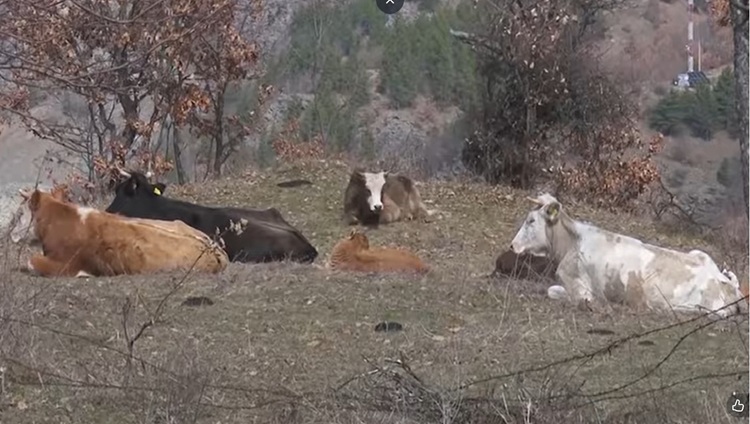
A long-running dispute over hundreds of freely roaming cattle in eastern North Macedonia has escalated into clashes, arrests and calls for military assistance, highlighting what critics say are deep failures by state institutions to enforce animal welfare and public safety rules.
The crisis centres on a herd of nearly 600 cows, valued by market estimates at about 1 million euros ($1.1 million), that for years has wandered through villages and farmland around Kriva Palanka, near the Bulgarian border. Local residents say the animals have destroyed crops, entered private property and posed traffic risks on a major cross-border road.
Tensions flared in recent days in the village of Dobrovnica after farmers, seeking to prevent further damage, confined some of the cattle in their barns. Owners of the animals attempted to free them, leading to verbal and physical confrontations that were captured on social media. Police later detained one of the cattle owners following resistance to inspectors seeking to seize the herd.
Health and veterinary authorities say the Agency for Food and Veterinary Affairs issued a final decision more than a year ago to confiscate the animals due to neglect and violations of animal welfare laws, effectively placing the herd under state responsibility. However, the ruling has not been enforced, leaving the cattle in legal limbo and the dispute unresolved.
Residents, farmers and even some of the cattle owners have appealed to local and national authorities, warning that delays increase risks to both people and animals. Some officials have proposed declaring a local crisis and involving the army to safely remove and transport the herd using military engineering equipment.
“The problem has existed for years and everyone agrees it threatens public safety, agriculture and the animals themselves,” said one local official, who blamed overlapping responsibilities and inaction by institutions.
The government has not announced a permanent solution. As the standoff drags on, villagers say frustration is growing, while animal welfare groups warn that prolonged uncertainty could worsen conditions for the cattle.
The case has drawn wide attention domestically, becoming a symbol of governance challenges in a country seeking to strengthen rule of law and institutional capacity as part of its European Union aspirations.