


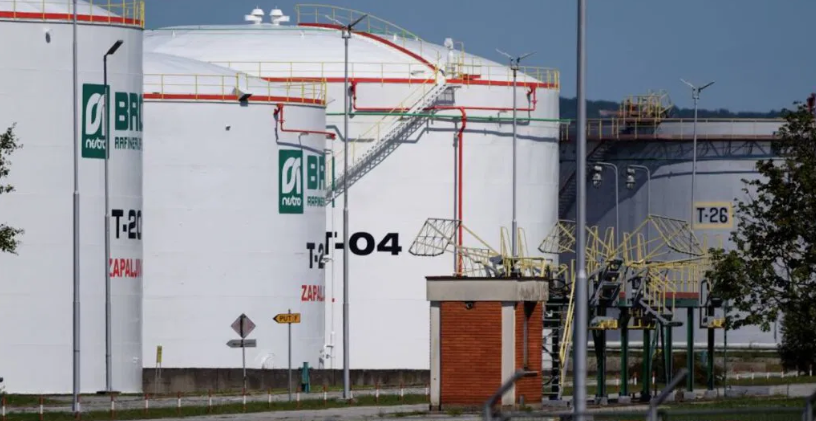
Serbia will halt operations at its Pancevo oil refinery after the United States declined to issue a licence needed to keep the facility running, President Aleksandar Vučić said on Tuesday, confirming weeks of uncertainty over potential U.S. sanctions against state-backed energy group NIS.
The shutdown will also affect Petrohemija, Serbia’s largest petrochemicals producer, raising concerns about the country’s energy security and the fate of thousands of workers linked to the sector.
Although Washington’s warnings over sanctions have circulated for months, Serbian officials made a push for solutions only recently.
At a panel on Serbia’s energy outlook held in Belgrade on Tuesday, energy and economic experts said years of policy failures had left the country exposed.
‘Planning chaos’ and overreliance on imports
Damir Dizdarević of the BFPE Foundation for a Responsible Society said Serbia lacked long-term planning and had adopted conflicting strategies that he described as “dimensional-planning schizophrenia.”
“We don’t have coal, we don’t have enough energy for our needs, let alone for future demand,” he said.
Ilija Batas Bjelić of the Serbian Academy of Sciences and Arts said Serbia had become overly dependent on foreign suppliers of oil and gas, while neglecting domestic potential. “We even handed our own resources to other companies thinking we cannot manage them,” he said.
Energy journalist Milena Maglovski said Serbia invested too little in solar, wind and biogas despite having stronger solar potential than Germany. “It’s not just about resources but about political will to carry out a transition,” she said.
Workers left in uncertainty
Union representative Zoran Obradović of UGS Nezavisnost warned that the closure of Petrohemija could leave “hundreds of thousands of people” who depend on the company without an income.
“It is unbelievable that the state has never once called the unions to discuss what happens to these workers,” he said.
Vučić said Serbia had given Russia until Jan. 15 to decide whether it would sell its stake in NIS. Several potential buyers are being discussed publicly, including Hungarian oil group MOL.
Call for new energy policy and EU alignment
Energy expert Aleksandar Kovačević said Serbia needed a “completely new energy policy” after decades of stagnation, including investment in navigation along the Danube and better management of the Đerdap and Danube–Tisa–Danube systems.
Economist Goran Radosavljević of the FEFA Faculty urged Serbia to align policies with the European Union, warning that missing the next enlargement window around 2030 would leave the country isolated. “Otherwise we risk becoming a black hole in terms of economic development,” he said.