


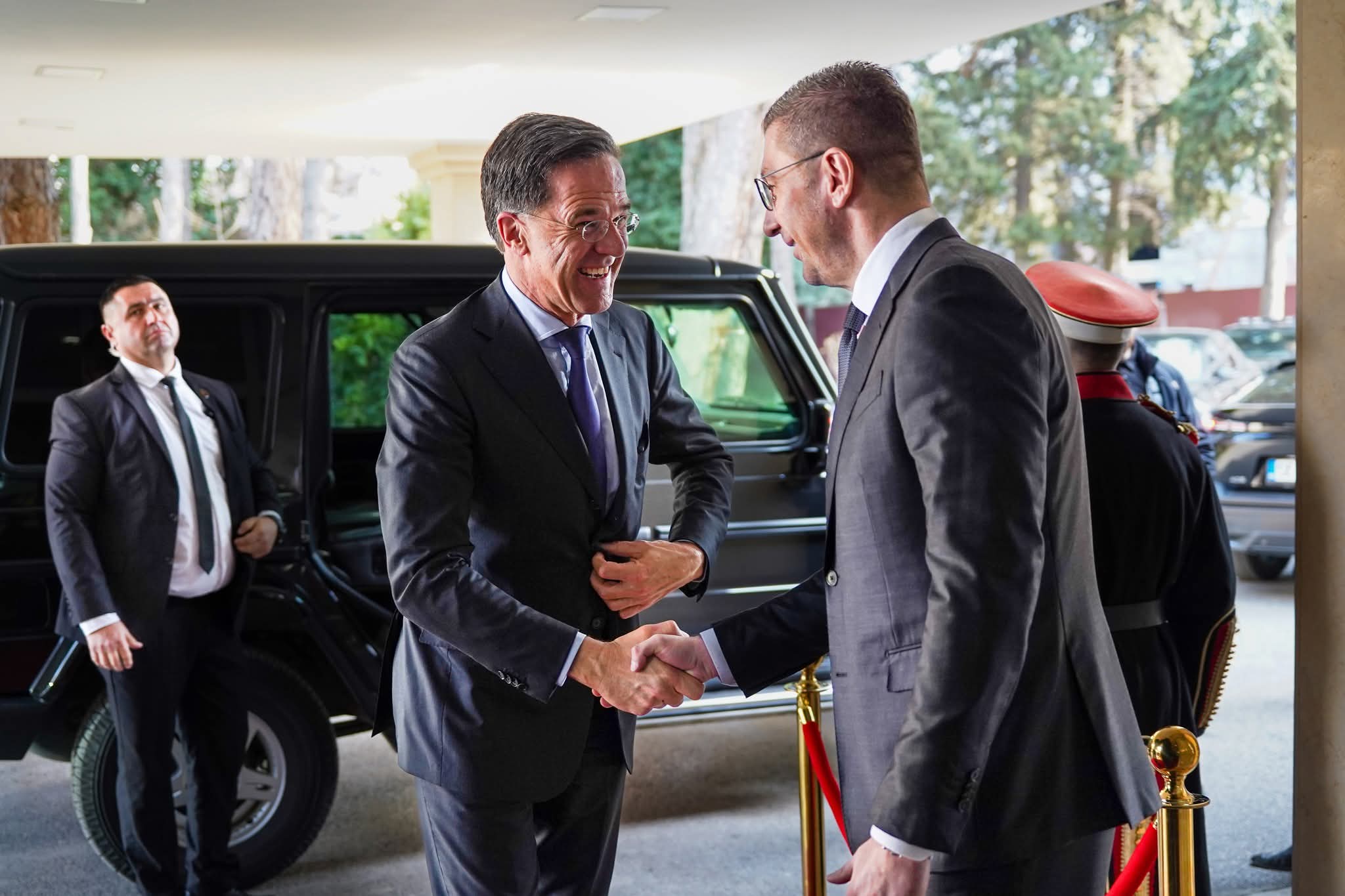
Mark Rutte used his first official visit to North Macedonia as NATO chief to reassure allies in Southeast Europe that the alliance would defend “every inch” of its territory, as war escalates in the Middle East and fighting continues in Ukraine.
Rutte’s trip comes at a moment of heightened global instability, with U.S. and Israeli strikes on Iran fueling regional tensions and Russia’s war in Ukraine entering another year. Although North Macedonia is geographically distant from the Middle East, its NATO membership places it firmly within the alliance’s collective defense framework.
“NATO is not involved in the U.S. and Israeli campaign,” Rutte said at a joint press conference with President . “But let me be clear: NATO will defend every inch of Allied territory.”
NATO distances itself from Iran strikes
Asked about U.S. military action against Iran — a NATO member acting independently — Rutte stressed that the alliance as a whole is not participating in the operations.
He described Iran as a long-standing source of regional instability, citing its nuclear and ballistic missile programs as security concerns not only for the Middle East but also for Europe. Rutte underlined that his criticism was directed at the Iranian regime, not the Iranian people.
While some NATO member states may provide logistical or political backing individually, he emphasized that the alliance itself is not a party to the campaign.
Defense spending and regional role
Rutte praised North Macedonia as a “loyal and valuable ally,” highlighting that the country spends more than 2% of its gross domestic product on defense, meeting NATO’s benchmark target.
“This is significant progress,” he said. “We must increase defense investment and ensure our forces are fully prepared.”
North Macedonia contributes troops to NATO battlegroups on the alliance’s eastern flank and participates in international missions, including KFOR in Kosovo and the EU’s EUFOR Althea mission in Bosnia and Herzegovina. Though small in size, the country has sought to position itself as a reliable contributor to collective security since joining NATO in 2020.
EU membership seen as key to Balkan stability
President Siljanovska-Davkova said that beyond NATO’s security umbrella, full integration of the Western Balkans into the European Union is essential for long-term regional stability.
“The greatest investment and guarantee not only for our security, but for Europe’s security as a whole, is EU membership for the Western Balkans,” she said, calling for what she described as the removal of artificial obstacles in the enlargement process.
Her remarks reflect broader concerns in the region that delays in EU expansion could leave space for external influence from rival powers.
Meetings with government leaders
During his visit, Rutte also met Prime Minister and Parliament Speaker , reaffirming North Macedonia’s commitment to collective defense and alignment with Western security policies.
Addressing lawmakers in parliament, Rutte devoted a significant part of his speech to Ukraine, saying that when the war ends, any peace must be durable.
“Ukraine’s security is our security,” he said, warning that Russia, China and Iran are increasing their capacity to challenge the Euro-Atlantic community.
The visit marks Rutte’s first trip to Skopje as NATO Secretary General. His predecessor, , visited the country in 2023.